
Hanoi: Tran Nhat Duat pedestrian bridge becomes a public art space
The group of artists had the idea of turning the pedestrian bridge into a joyful and lively one, illuminated in the evening by the light of public art installations, some of which were made from materials Recycling.
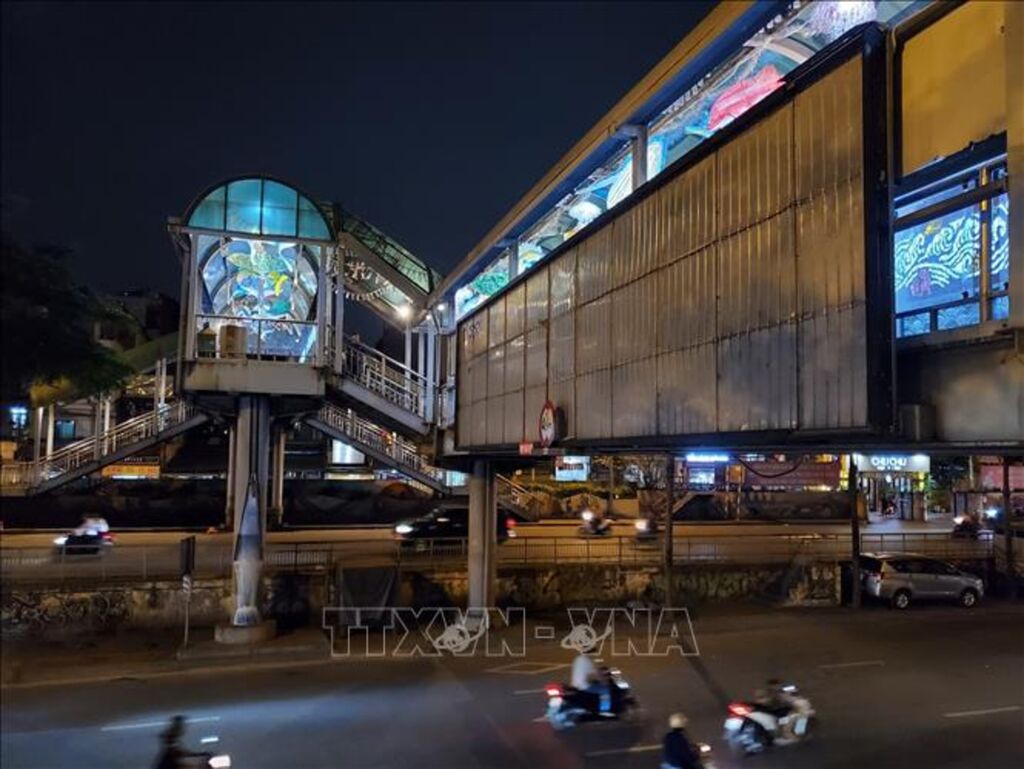
The public art project on Tran Nhat Duat pedestrian bridge, Hoan Kiem (Hanoi) was officially launched on the evening of April 23, creating an additional sightseeing highlight for residents and tourists. The project was carried out by a group of artists in Hanoi, celebrating the 49th anniversary of the liberation of the South and national unification (April 30, 1975 – April 30, 2024) and International Labor Day, January 1. 5.
The pedestrian bridge on Tran Nhat Duat street is a pedestrian traffic path connecting Hanoi’s Old Quarter and Phuc Tan area, Thanh Yen border gate, Hoan Kiem district. Every day, the majority of bridge users are older people, street vendors and students. The density of people passing by is not too high. At night the light is not enough so the bridge surface is quite dark.
From the above current situation, the group of artists had the idea of turning the pedestrian bridge into a joyful and lively one, illuminated in the evening by the light of public art installations, some of which were used from recycled materials.
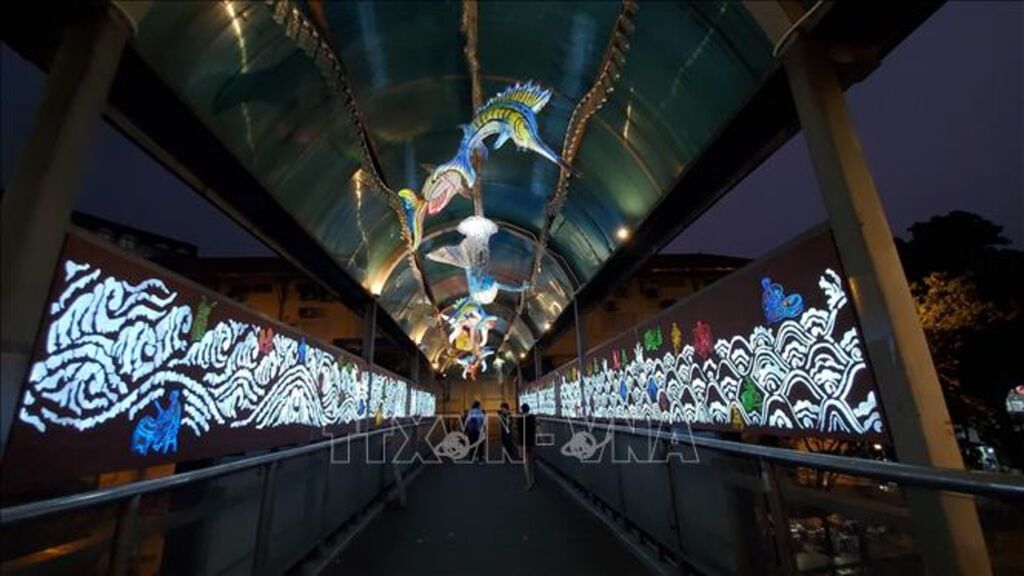
With the theme “Water”, the installations interact throughout the pedestrian bridge, thereby transforming the bridge into a collection of light installations. The work “Aquarium” by artist Vu Xuan Dong evokes the feeling of an attractive aquarium tunnel with all kinds of ocean fish swimming above the bridge arch. Fish, squid, jellyfish… are made from plastic bottles, plastic cups, plastic straws, recycled nylon… collected from all over the city. The author arranged ocean fish species to absorb light from the spotlight system along both sides of the bridge arch as well as the LED lighting system inside.
Along the bridge corridor, the light installation with the theme “Waves” by artist Le Dang Ninh also evokes memories of the waves of the Red River transporting silt throughout the nation’s history. Interspersed among the waves are images of workers in the study “Technology of the Annamese people” by artist Henri Oger.
At the foot of the walking stairs, from both directions, are painted paintings “Carp crossing Vu Mon” from the Hang Trong folk painting treasure trove. The work reminds of the learning journey of students climbing the stairs to school every day like the journey “Carp turns into a dragon”. With the theme “Water” there are two 3D paintings that interact with the bridge pillars to create a zipper image of flowing water and a 3D painting behind the dyke wall with paper boats that are very familiar to students.
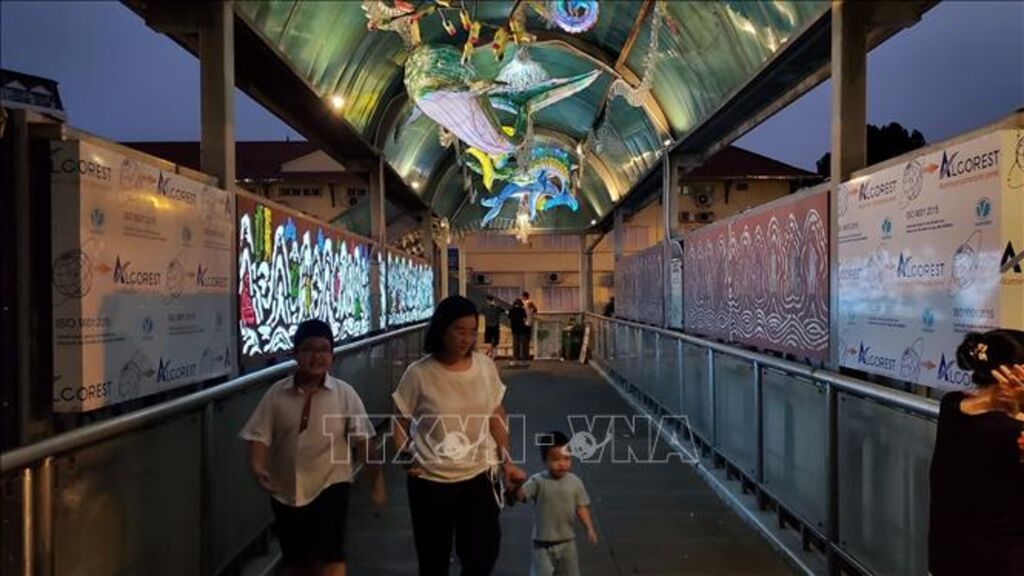
The pedestrian bridge with the theme “Water” is like a geographical link between the two areas of Hanoi’s Old Quarter inside the dyke and the Phuc Tan area outside the dyke. The bridge becomes a public art space connecting with Phuc Tan public art space, the Old Quarter and the location of 22 Hang Buom Cultural and Art Center. The above three locations and art spaces are connected together to create an attractive walking art tour, attracting tourists, stimulating economic and cultural development and enhancing cultural and spiritual life. for local people. The project helps stimulate the habit of walking to explore cultural and artistic heritage in the city, a habit that has also gradually developed again, helping to connect the community more effectively in recent years.
Artists participating in the project include: Vu Xuan Dong, Le Dang Ninh, Can Van An. The curator is artist Nguyen The Son. The group of artists participated in Phuc Tan Public Art Project, Phung Hung Public Art Project…/.