

Developing creative spaces in Hanoi
Currently, Hanoi holds about 60 creative hubs, including 7 co-working spaces, 42 creative spaces for culture and arts, and several other creative hubs. Meanwhile, these creative hubs haven’t received much attention from people and haven’t emphasized their position and role. Therefore, Hanoi must generate the growth of the creative hubs to strengthen its role in the socio-economic development of the Capital in the coming future.
1 – A creative hub is a place, either physical or virtual, which brings creative people together.
According to the British Council, It is a convenor, providing space and support for networking, business development, and community engagement within the creative, cultural, and tech sectors. Creative spaces are places for businesses within the creative industry sector to connect and mutually support each other to form a network through lending offices/ spaces to young artists for the displays, communications, art business, or entertainment space which brings art closer to the community. In Vietnam, most spaces are private businesses; they are located mainly in Hanoi and Ho Chi Minh City. Because the concept of spaces is new, most of the spaces are not legally received the incentives of the current system of policies and laws. Even though the spaces are based on community-oriented and are highly at risk, most of them operate under the law as enterprises or businesses.
Creative spaces play an important role in urban development within the following respects:
First, creative spaces create an identity of cities.
Creative spaces, especially artistic spaces, can balance development and conservation in urban areas, maintain and create an identity of the city. In many cities around the world, the growth of creative spaces has created a new mark for the city development. Thanks to the generating of creative spaces, many cities have transformed into attractive tourist and entertainment destinations. They are no longer the cities of the dusty and polluted industry. In Bristol (United Kingdom), Tobacco Factory Theater is a creative space built by converting an old building into a new symbol – a new identity of the city. Formerly, this creative space was a tobacco factory of Bristol, where about 40,000 residents lived around. After the recession, the tobacco factory had to close and even be abandoned. At the time, George Ferguson, a politician, had bought the factory and encouraged artists to transform it into an art venue. The talented artists brought the abandoned tobacco factory a new life with a theater space or exhibitions. Other services, in turn, were reopened And this former deserted area is now crowded with stores and a host of other services. By the art decoration, the tobacco factory is considered as a livable area to the residents. Moreover, with the dedication to art, George Ferguson became the first elected Mayor of Bristol from 2012 to 2016.
The lesson from Briston shows that we need to build a new identity of Hanoi by generating creative spaces. The old corners or buildings can be reused and redesigned for the current society purpose; they concurrently represent a thousand-year-old civilization of Hanoi. The integration of art and living spaces that makes life more active and happier is what creative spaces can do for Hanoi. Phung Hung Mural Street, Walking streets around Sword Lake, Trinh Cong Son Street … are the signals to shape the identity of the capital in the future.
Second, creative spaces make an attractive city.
Today, the competition between cities is increasingly fierce. Cities try to build their brands in many different ways such as organizing events, activities, or constructing buildings, bridges, etc. And the competition between the creative spaces also happens in the same way. At the national scale, the construction of creative complexes and smart cities is becoming a new trend that many countries are following.
Hollywood and Silicon Valley are the models that are cross-referred by many countries in their own way. In specific cities, cities strive to build their focal points through creative spaces.
In Bristol, Watershed is an organization that carries out projects of creating cultural and artistic activities and spaces. Bristol’s policy was to encourage the development of art to become a means of communication among citizens and between citizens and government. This policy came from a modern living philosophy that states that citizens become more and more actively involved in social life. Therefore, Watershed decided to build the creative spaces in Bristol as an experiment. They decorated the staircase to the station floor with music keys so that the stairs would make funny sounds. This innovation had motivated 66% of people taking the stairs instead of the elevator. This result creates not only the habit of taking the stairs but also the happiness and the health improvement exercise. Also, some places were installed light bulbs so that the residents can play with funny shadows under the light. Moreover, there are projects about making conversation with trees, lampost in Bristol…; these projects will draw the residents’ concern about the problems of the city. Since 2013, the target of Bristol’s authorities has been to change Bristol for a livable city; therefore, the mission of Watershed is to create that city target. Bristol sets an annual date – November 19 as a day of fun for the people of the city.
Hanoi also can refer to what Bristol had done to build the attractiveness. The slogan – the livable city should be accompanied by specific actions that mean people can participate in creative activities and entertainments. It’s a creative hub where people can find inspiration for creative activities and amusement.
Third, creative spaces inspire creativity
One of the difficulties, when young people start their career within the artistic creation field, is to find themselves a workspace, a startup space. Most of them are freelance artists – unstable and less frequent jobs or may take up artists as the side job. Moreover, the cost of renting locations in the central areas is often quite high; it is difficult for them to access though they are very in demand. Therefore, creative spaces have become a practical solution. Creative spaces provide the proper infrastructure for creativity, such as a workspace with lots of conveniences, studios, meeting rooms, events space, etc. Creative spaces are not in the same structure as traditional offices or administrative offices; these spaces are often comfortable, colorful, and unique in designs. They make people free their souls and inspire a creative feeling in artists.
Thus, with co-working spaces, creative individuals and startups will be provided with space to connect, share about careers, creative ideas, and access to venture capital for potential success. Commonly, these spaces lend startups the opportunity to access investors, take business courses, and connect with other businesses to accompany each other in the entrepreneurship process. Therefore, creative spaces are always toward facilitating and inspiring the creativity of individuals and businesses. Da Nang city was more active when DNES (a co-working space and a business incubator of Da Nang) was set up in 2015 by Danang authorities in the form of public-private partnerships to develop entrepreneurial and creative ecosystems. And there are the spaces similar to DNES in Hanoi: Heritage Space, Hanoi Creative City, Toong co-wỏking space, Lotte Start-up Support Department, etc.
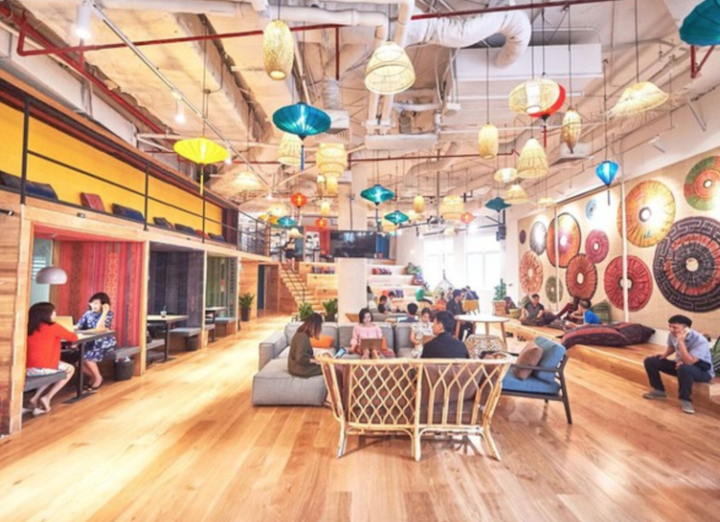
Naked Hub has been present in Hanoi_Source: nhipcaudautu.vn
In terms of cultural-art creative spaces, a hub is a place for artists to exhibit and introduce their creation, art experiment, and also attract the community to participate in art. VICAS Art Studio is a center for contemporary art support and development under the Việt Nam National Institute of Culture and Arts Studies. This space organizes art exhibitions on different topics: Spring Garbage, Through the Northwest, Truth or Fiction, Forever Love, The Swirl of Silence with social meaning – branding for artists, connecting artists to the market and audience. Another example is Saigon Outcast, an open space that connects art lovers and operates for the community purpose by organizing exhibitions, festivals, events, from which everyone has joined in not only the activities but also charitable donations. In addition to the creative spaces above, there are many spaces like these in Hanoi as well as other cities. All off them have one thing in common is to inspire creativity and spread emotion in the community. The outcome of creativity and art produced in these creative spaces will help people and life become more beautiful, compassionate, joyful, connected, and livable.
Finally, creative spaces can regenerate cities.
Creative spaces help create new business models. They also encourage and build creative associations, experience, skills. In Hanoi do many factories need relocating to reduce pollution. Therefore, studying and constructing artistic structures, creative spaces to replace these factories can revolutionize the previously polluted areas that are more beautiful and attractive. Some typical areas are facing the pollution problem: the areas along Nguyen Trai Street, around the rubber factory, soap factory, and tobacco factory. However, by constructing more creative spaces and greenery parks, these areas will be livable. Moreover, the arrangement of amusement parks for creative activities of the community should always be considered when new urban area’s constructions are planned.
2-While having brought many benefits to urban development, creative spaces in Hanoi are facing many difficulties in their development. To solve these difficulties, Hanoi must follow all the below solutions:
First, All levels and branches of government need to build their awareness of creative spaces in the development of the Capital.
The creative spaces are not only for business, entertainment but also to create a driving force for city development. Currently, in the context of the Fourth Industrial Revolution, the creative industry is holding many opportunities to develop. Therefore, Hanoi must also see the indirect benefits and added values of such spaces. These benefits could be the contribution to city identity, city image promotion, the increase in the attractiveness of the Capital, and the effects on other socio-economic branches.
Second, perfecting the policies system is to facilitate the development of creative spaces of the Capital.
Now, creative spaces are facing a lot of challenges in operation. As a result, the creative spaces’ cycle( cycle of the establishing, existing, developing, and decommissioning) comes to an end fast. With this fact, creative spaces can not be treated as normal businesses because the characteristics of these spaces are experimental and community-oriented. The reality shows that success in the creative sector can bring a lot of profits to creators, communities, and countries, such as Facebook, uber, grab, amazon …, also point out about 80% of bold ideas have failed. Nurturing dreams and creativity must be done in a different way than usual, so the city authorities should have preferential policies on land, urban planning, tax, defined locations. Only when people thoroughly know that spaces operate under the law as non-governmental organizations (NGOs), community-oriented organizations will the creative spaces in Hanoi have more opportunities for development.
Finally, mobilizing resources for creative spaces.
Now, most creative spaces in Hanoi are individual initiatives, the brainchild of small groups. Because the individual efforts fail to overcome the obstacles of profit; the enthusiasm decrease over time, creative spaces in Hanoi only exist in a short time. To enhance creative spaces, the city authorities need a mechanism creating resources to support the research and testing of creative space development plans.
Besides, the fundraising for supporting the creation, venture capital can also make private investors, foreign venture capital, and businesses join forces with the Capital authorities to promote creative spaces.
By Associate Professor Tu Hoai Sơn (Communist Review)