
HANOI URBAN RAILWAY: OLD HERITAGE, CREATIVE SPACE TODAY
Hanoi is a city that converges traditional and modern beauty, which connects the historical and quintessential sources of the nation. In the thousand-year flow, urban railways have marked a part of it, affirming their strong, long-lasting vitality.
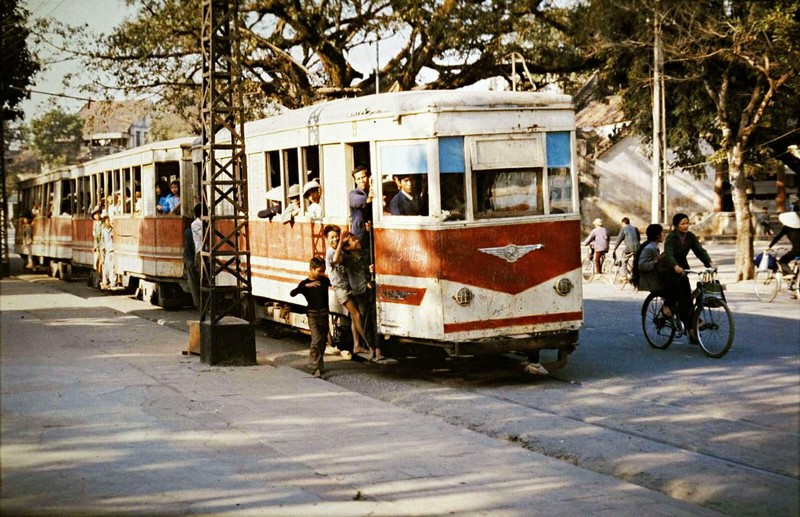
Old Hanoi Tram.
“Missing the tramway jingle early in the morning and at night”
It has been 120 years since the Tramway de Hanoi (French) built by the French was put into operation (in 1901). Along with the planning of the West Quarter, the Hanoi metro system is the hallmark of the shift from the feudal urban model to a modern one.
At that time there was an anonymous folk verses telling about the changes that the West had brought to Vietam such as lamp, tramway, station, booking clerk. Initially only 3 railway with a length of 10km, after expansion and development process, the Hanoi tramway network had have 5 railways with the total length was approximately 50km by the end of the 1920s. The railway at that time were radial in design; as the design, the tramways gathered in the north of Hoan Kiem Lake (near the “Shark Jaw” building now). From this location, the train radiates 6 directions, connecting the city center with suburbs such as Buoi, Cau Giay, Yen Phu, Ha Dong, Cho Mo, Vong (Bach Mai Hospital). It can be seen that the placement of the center of the railway at Hoan Kiem Lake has made a special attraction for the tramway. A modern and civilized transport system at that time was formed, which not only affirmed the role of transportation but also enhanced the beauty, the characteristics of the landscape of Hoan Kiem and the Old Quarter, French Quarter.
At first, the Hanoi tramways were only painted in a red-brown color and the seats were aranged in horizontal . After that, they were painted in red and blue and there were coup seats for 2 people seated together. Trams are convenient means of public passenger transport, especially inexpensive, serving the poor and trasport passengers from the suburbs into the city. The ticker cost only 5 cents, equivalent to the price of a banana or a bowl of pho.
Not only a means of public transport, the tram is also a characteristic culture, familiar to Hanoians. Giving up seats to the elderly and women was once considered “tram culture”, an typical manner for the lifestyle of Hanoians. The sound of “tram jingle” and the images of the “Bo Ho tram” are still preserved in the stories passed down through generations; the stories have proved the cultural and historical value of the tram in the memory of the people.
In early 1990, under the pressure of socio-economic development, the Hanoi tram officially closed and ended its mission to serve the people because it could not meet the traffic needs in the city at that time. The trams were quickly removed in the regret of so many people. Hanoi has lost its “leng keng” the sound of the values to be considered a potential heritage.
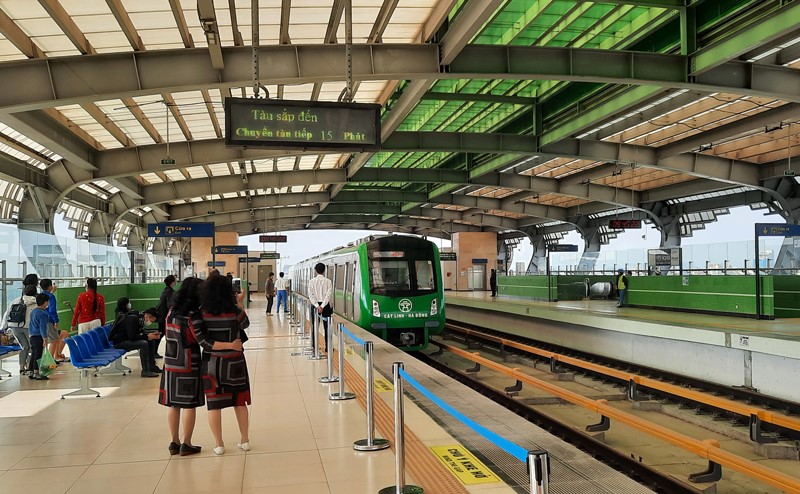
Hanoi urban railway stations promise to be new creative spaces. Photo: Ha Anh
New creative hubs
Entering the second decade of the new century, when the “leng keng” sound is still in the sweet memory of many Hanoians, the city also began to form new urban railways. And after more than a decade of construction, Cat Linh – Ha Dong metro line (line 2A), the first urban metro, has been put into operation and operated at the end of November 2021. With strong, fast and superior qualities, urban railways will become the backbone of Hanoi’s public transport network. Each train can carry thousands of people, go overhead or underground. Unlike the tranquil beauty of the train, the metro and subway bring modern beauty to the city. And at each metro station, passengers can see the different land of Hanoi thousand years of culture through the image at the station.
Not only serving the travel needs of people, the urban metro network is expected to connect the cultural and historical space of Thang Long – Hanoi; contributing to raising the position of the central urban in Vietnam and the region. In many developed countries such as the US, Russia, Japan, Germany …, subway stations are both transportation and architectural works, art creative spaces, commercial centers to meet the people needs. For example, Avtovo Station in Saint Petersburg (Russia), San Giovanni Station (Rome, Italy) or Alexanderplatz Station (Berlin, Germany) are underground heritage museums, displaying images and artifacts according to each layer of urban development history. The spaces of Hanoi urban railway station are crowded places, designed with modern construction, promising to be creative and artistic spaces, exhibition spaces for artifacts, images of culture and history of Thang Long – Hanoi, becoming the highlights of the Capital in the era of integration and development – attractions, shopping, check-in attracting visitors.
In particular, Hanoi lovers will be very happy if there is a station arranged to become a display space, even restoring models and the “leng keng sound” to preserve and introduce beautiful memories of the old tramway – a means of transportation of a historical period, an enduring cultural beauty of the Capital.