
TRANSFORMATION OF OLD FACTORIES IN HANOI
Transformation of “manufacturing industry” infrastructure into “creative industry” and “social infrastructure”, a “hinge” strategy needs to be integrated in the “Adjustment to Hanoi Region Capital Construction Master Plan to 2030, with a vision to 2050”
“Adjustment to Hanoi Region Capital Construction Master Plan to 2030, with a vision to 2050” is an opportunity for us to look back at the problems of the Capital, new potential for comprehensive and sustainable development; moreover, it is also an opportunity to innovate thinking, adjust and perfect to catch up with the global movement, apply scientific and technological achievements of the world – The Master Plan after being adjusted will be a basic legal framework for managing and unlocking the abundant energies in society for ensuring the strong and sustainable development of Hanoi in the next 10 and 30 years. The article raises the issue of “Developing infrastructure for cultural industry on the basis of exploiting old industrial facilities in Hanoi” – This is a great opportunity to make Hanoi achieve many development goals in economic aspects, social and environmental in a sustainable way.
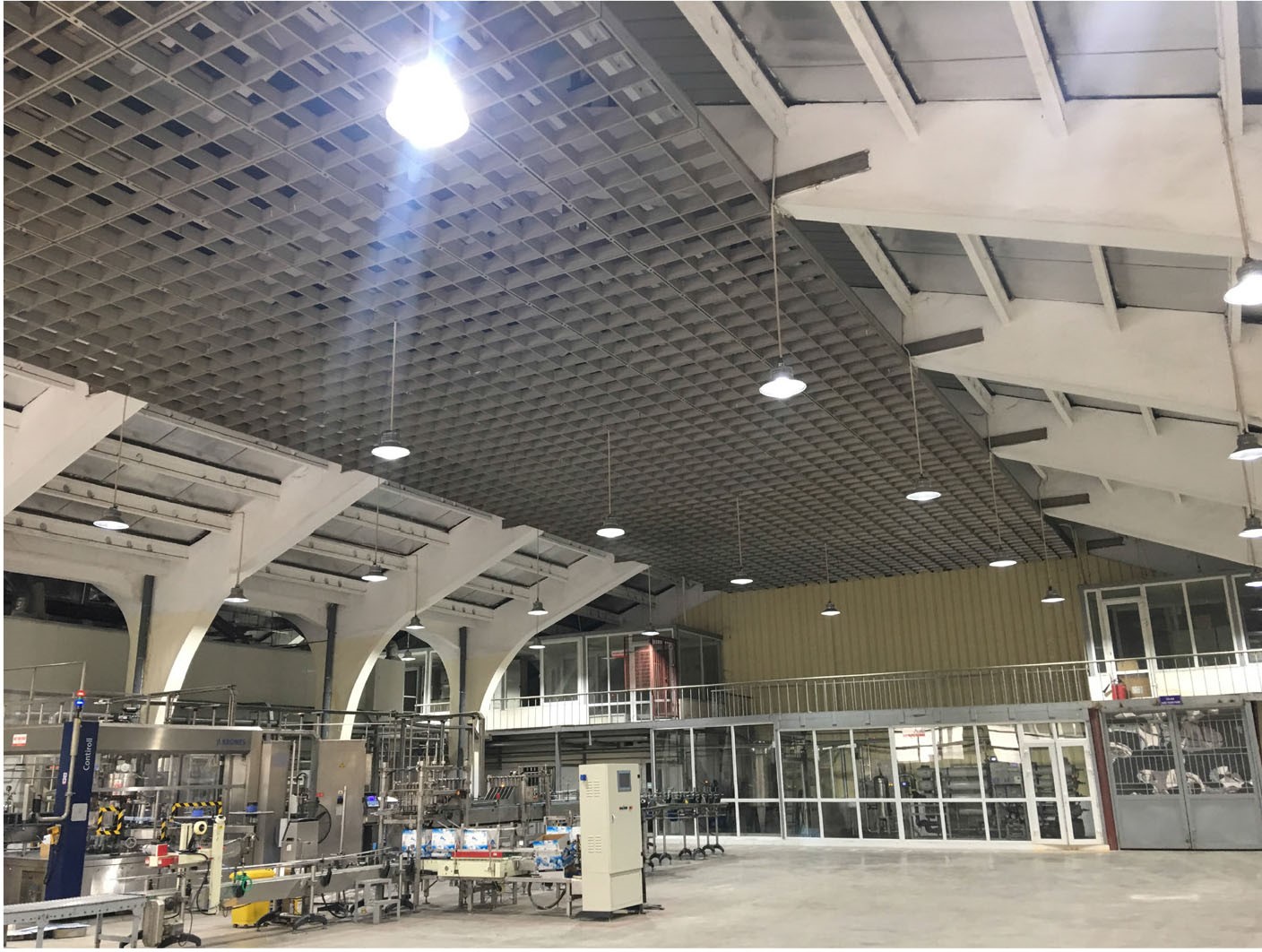
The production factory’s interior of Hanoi Brewery – very suitable for indoor cultural event spaces
Hanoi – opportunities and challenges for a creative and livable city
Air pollution and lack of Public Space
Despite being the capital and the second largest city of the country with economic growth in the leading group in the country, Hanoi still “loses points” due to 2 basic issues related to “quality of life” – Air pollution and lack of public space.
That air pollution is higher than the permitted level is quite frequent in Hanoi – very harmful to human health. The level of air pollution in Hanoi is always higher than other major cities of Vietnam, and also at a much higher level than other cities in Southeast Asia and Asia – This in the long run will greatly affect the quality of people life, not attract foreign tourists and decrease the city’s ability to integrate internationally.
The main reasons of air pollution include the overload of motor vehicles (7 million two-wheelers and 1 million personal cars); pollution caused by industrial production, handicrafts. And some indirect reasons are the inefficient management capacity to implement urban planning and the unfit development policies, which is hampering the implementation of the policies for population expansion, reduction of pressure on Hanoi’s inner infrastructure for many years. After being removed, many old factories was transformed into ultra-high-density urban areas such as Royal city, Times city, causing a sudden increase in load on the city infrastructure and inner environment.
The next city problem is the lack of public space. It can be said that the space for green tree, water is a basic social infrastructure of cities, and especially important factor for “livable cities”. According to the survey data in 2010 under the Planning Project of Trees, Parks and Lakes in Hanoi, the average area of green park was only 1.58m2/person, dropped to 2.17m2/person in 2000. This statistic is only 22% more than the requirements of the Vietnam Construction Regulations (7m2/person – excluding the space of green parks in urban areas) and only achieved 17.5% compared to the World Health Organization’s standard of 9m2/person.
A survey on the role of the public space in the lives of people in Hanoi done by Pharmaceutical Product Working Group (PPWG) in August 2020 showed that: More than 92% of respondents said that public space is important to their lives, 28.89% said that it is really important. More than 80% respondents felt that there was a lack of the public space, 28.14% of them said it was too lacking.
Solving these two problems is not easy, especially in the context of a crowded urban area, with a dynamic market economy. But without the government’s comprehensive and drastic interventions, the problem will only get worse.
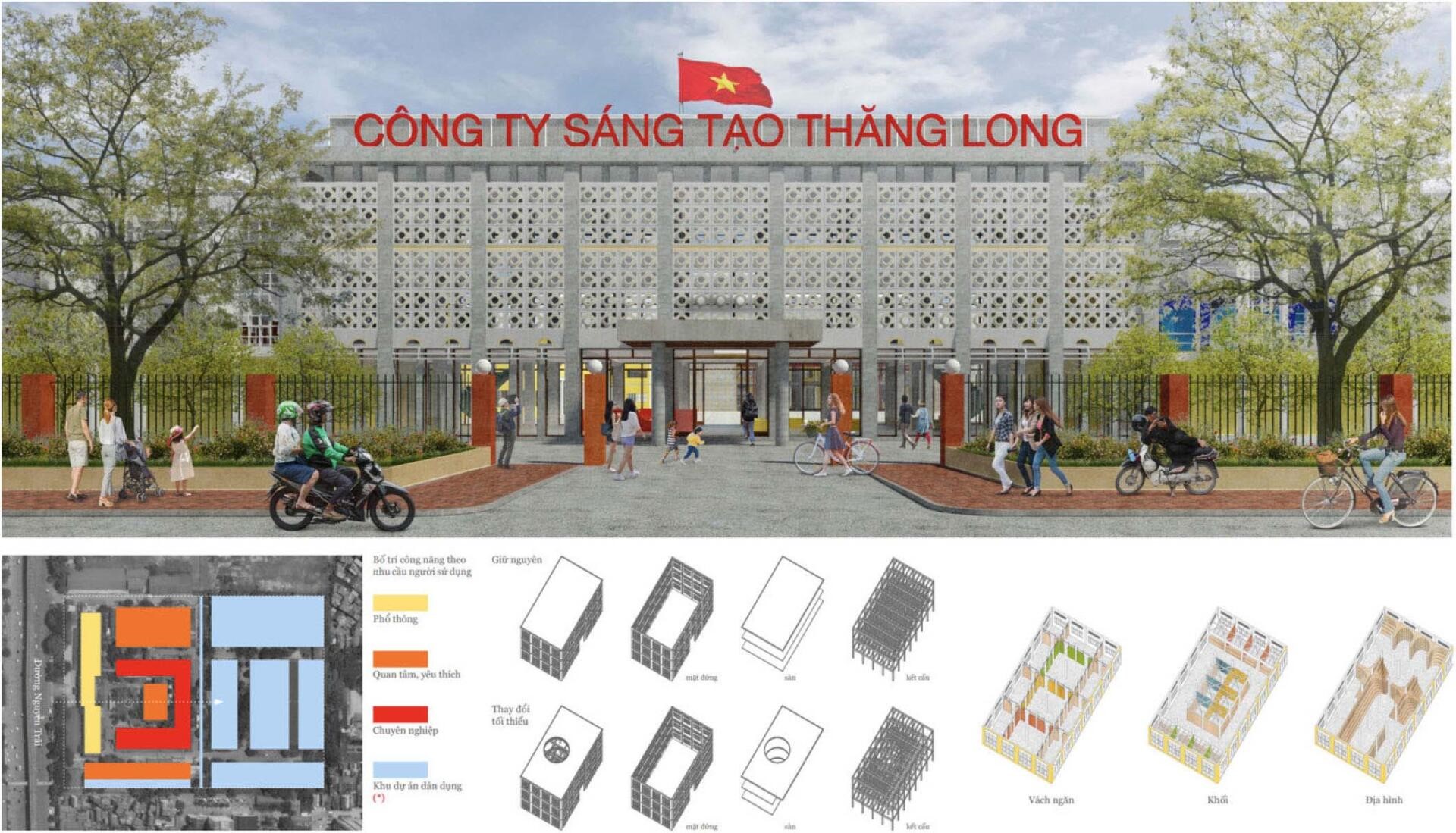
An idea of preserving and transforming Thang Long Tobacco Factory into Thang Long Creative Culture Space – Plan of The Thang Long Tobacco Factory
Guidelines, policies and implementation of the relocating the polluted factories from the inner city
Since 2003, the Prime Minister has issued Decision No. 64/2003/QD-TTg (referred to as QD 64) dated 22/04/2003 approving a plan for thoroughly handling establishments which cause serious environmental pollution; Accordingly, on 17/06/2003 Hanoi People’s Committee issued Decision 74/2003/QD-UB to implement the direction on the following years, this policy has been affirmed in a series of important legal bases including: Region Capital Construction Planning to 2020, with a vision to 2050 (approved on May 5, 2008), Region Capital Construction Master Plan to 2030, with a vision to 2050 (approved on July 26, 2011); Capital Law (effective 2012); Decision 353/QD-TTg dated March 25, 2013 of Government inspector promulgating the implementation plan of the Capital Law, and Decision QD 130/QD-TTg in 2015 promulgating “Measures, roadmaps for relocation and use of land funds after relocation of industrial production establishments, hospitals, higher education institutions, vocational education institutions and agencies and units in the inner city of Hanoi” aims to eliminate sources of pollution caused by industry, reduce the concentration of population, reduce pressure on the technical and social infrastructure system having overloaded in the Capital for a long time.
Despite the strong legal bases as above, the practice of relocating functional facilities in general, and specifically industrial production facilities in particular, has 2 inadequacies:
- Actual relocation progress has been slow, due to the lack of implementation policy mechanisms. By the end of 2019, the list of industrial facilities in need of relocation in Hanoi still has nearly 100 facilities.
- If there is a relocation, the change of purpose is not in accordance with the Prime Minister’s QD130, Article 3, stating: “The land funds after the relocation of industrial production establishments, higher education institutions, vocational education institutions, agencies and units is prioritized for construction, development of public works, trees, parking lots, social infrastructure works and urban engineering; do not increase the load for the inner city area to ensure the balance of the needs of social infrastructure, technology and urban environment, not used to build high-rise apartments in the wrong planning”. However, most of the old factories relocated are converted into high-density new urban areas, high-rise commercial apartments after being reloated, which completely contrary to Article 3. There are some examples such as: Hanoi Mechanical Factory transformed into Royal City, Textile Factory 8-3 transformed into Times City, Mechanical Factory 120 at 609 Truong Dinh transformed into Nam Do Complex, Trang An Confectionery Factory transformed into Trang An Complex. PPWG’s survey in 2020 showed that: 19/21 factories in Hai Ba district, after the relocation, they have been converted into a commercial apartment complex – accounting for 84% of the land fund.
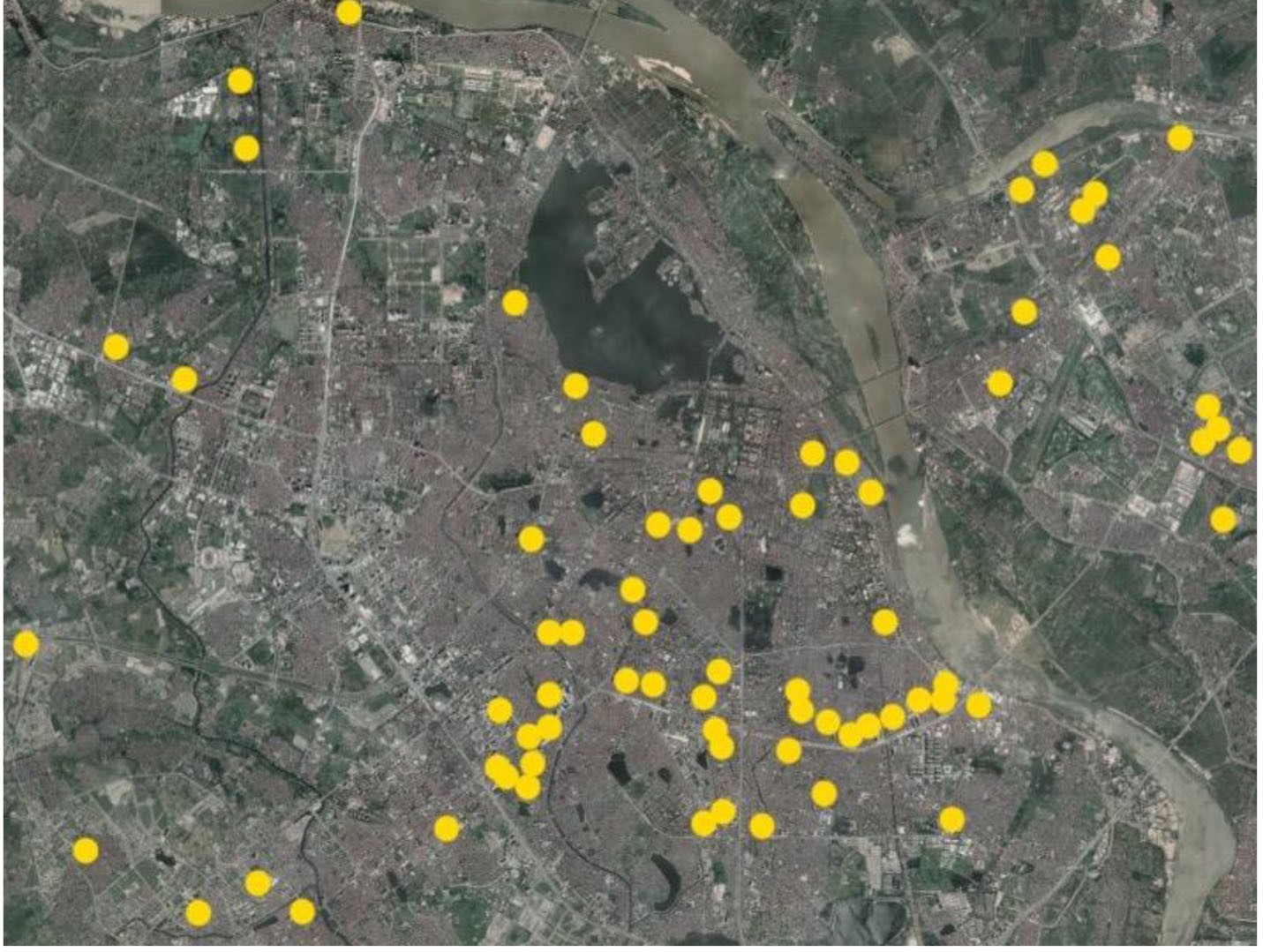
Map of distribution of 92 factories in Hanoi in the relocation list 2019 (Source: Author)
Hanoi and cultural industry development strategy
On 22/11/2018, the Hanoi Committee issued (together with Decision No. 15-QD/BCD of the Program Steering Committee No. 04-CTr/TU City Committee) the Project “Evaluation and proposal of solutions to develop the capital’s cultural industry in the period of industrialization, modernization and international integration”. The project affirmed: “Developing the cultural industry is a reasonable choice, because it is catching up with the most advanced global movement, and being the best suited to the internal resources of the Capital, promoting the great potential and strengths of Hanoi”. The gradual construction and development of the cultural industry in Hanoi is an urgent political task of Hanoi.
Hanoi joins UNESCO Network of Creative Cities
With the strength of a city rich in cultural traditions, where a large number of people participate in cultural activities and scientists of the whole country, in October 2019, Hanoi officially enrolled in the UNESCO Creative Cities Network in the field of design. This is an affirmation of the city’s great potential in developing cultural industries and creative industries, as well as a condition for the city to increase competitiveness in attracting investment, urban development, focusing on educational programs and cultural events…
The above are the problems, both old and new, posed to Hanoi, for which a wise consideration of converting old factories will be the key to solving many of these conundrums at the same time.
Old factories in Hanoi – Opportunities to transform them into infrastructure for cultural industry and public spaces
Survey on 92 old factories
Based on the list of old factories that need to be relocated due to polluting production or not in accordance with the plan, which was reviewed and finalized by the end of 2019, there will be 92 old factories and industrial production facilities that need to be moved out of 5 urban districts. If the small production facilities that are no longer in operation or abandoned are counted, the number is much larger. It is worth noting that if the above factories are converted for the public use (including cultural and creative spaces), it will significantly improve the the public spaces for Hanoi, especially in terms of “access” and these are probably the last chances, the only way to improve the public spaces in the inner city of Hanoi which has been and is overloaded.
After being relacated, factories have special potential to become the infrastructure of Industry and Culture
A survey done in October 2020 by experts from the “Network for a Livable Hanoi” reviewed all 92 factories, and deeply surveyed 10 selected factories, in order to evaluate the overall location, scale, current status of facilities, current status of production, the current state of management, and also the values of history, heritage, memory; thereby evaluating the potential and opportunities to transform into cultural and creative spaces, public spaces, which is the infrastructure of industrialization for Hanoi. The survey results show:
- These displaced industrial facilities have a fairly diverse status in terms of location, land size, type of enterprise, production and business status, status of facilities, factories, as well as their architectural and historical values;
- Some factories have intact and very valuable space and architecture funds, even the most modern and beautiful structures in Hanoi and the North (based on the aesthetic point of modernism) at the time of construction. Typically, Gia Lam Railway Factory, Hanoi Brewery, Thang Long Tobacco Factory, Dong Xuan Knitting Factory;
- Many factories play the role of giving birth to an industry in Hanoi, representing the development of society and urban areas in a historical period, marking important milestones in the history of modernization, urbanization, industrialization in Vietnam and Hanoi… and become the hallmarks of memory and image of the city.
In professional language, many factories can be considered “Industrial Heritage”, or “valuable structures” that need to be included in the protection list under the Heritage Law, the Architecture Law and other necessary tools.
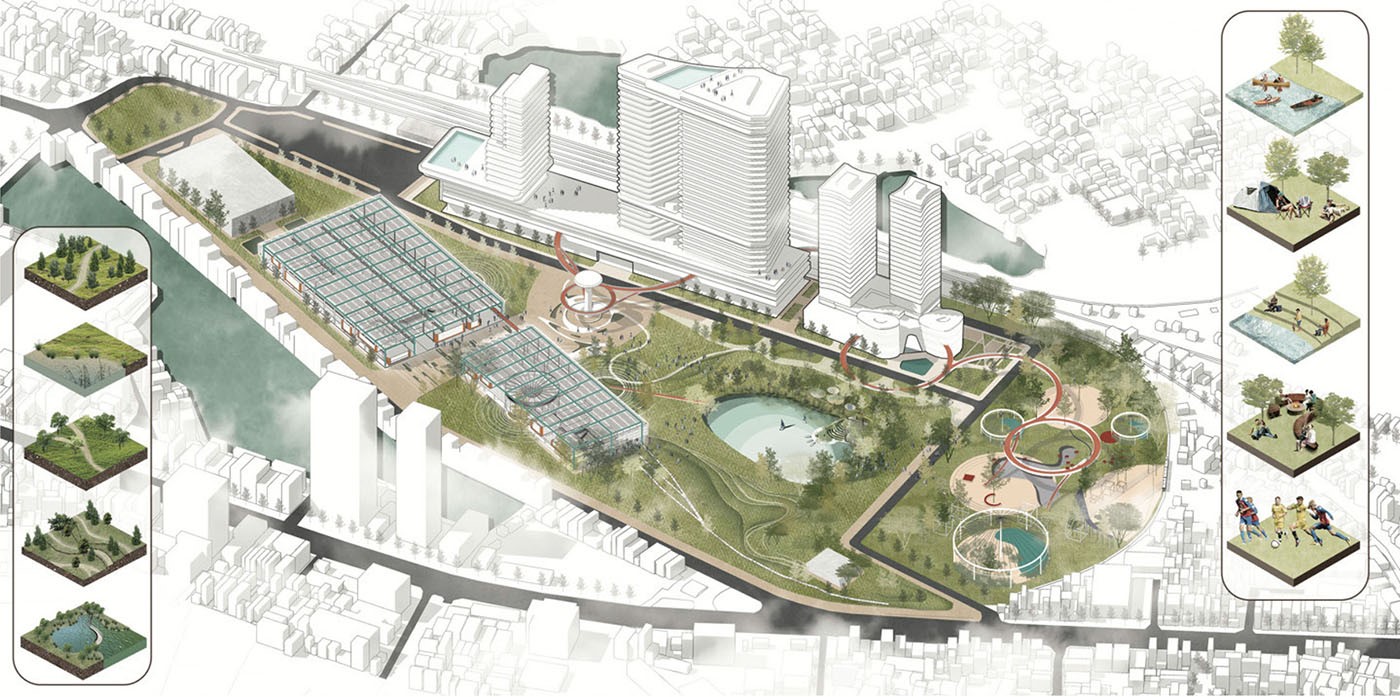
Gia Lam Railway Factory – Converted into a Service Trade Center associated with Gia Lam Station, combining creative cultural space (Idea from Hanoi Creative Space Design Contest)
Post-relocation factories have special potential to become the infrastructure of cultural industry
World experience shows that cultural and creative space is a type of material and spatial infrastructure essential for the culture industry and creative economy to develop.
(1) Creative spaces should allow for diversity, flexibility, and scale and must meet the diverse needs of a wide range of artists, entrepreneurs, and creative groups; At the same time, it is also necessary to attract a variety of public to the venue, creating a meeting point for supply and demand of the market.
Old factories: Very suitable and meet this characteristic well. The plant is usually a large ensemble with constructions and free space between them. Factories are usually large, or super large spaces, which can be divided, divided, partitioned flexibly, conveniently, or can be used as a large indoor space, very suitable for crowded events such as exhibitions, performances, performances. In general, old factories can adapt to many different usage scenarios that office buildings can hardly meet.
(2) Creative spaces needs to have cultural attributes and be able to stimulate creativity: It is necessary to stimulate imagination, create a creative atmosphere, meet the needs of creating a new personal mark of creators. Spaces with cultural characteristics, containing historical elements, heritage, creating a “sense of place” will be especially suitable for creative people.
Old factories: Are historical spaces and often contain architecture with heritage values (cultural properties), spatial forms, structures, details, materials different from ordinary residential spaces, helping to evoke new ideas, awakening creative potential.
(3) Creative spaces needs to have reasonable and cost-effective rents: It is necessary to allow quick setup, repair and decoration, easy, cost-effective, cheap rent, suitable for groups and individuals who are starting creative experiments and start-ups.
Factories: Often have beautiful architecture in a simple way, superficial building frame, basic technical infrastructure, industrial details available to take advantage of even in both use and decoration without much cost. In addition, the simple initial condition of the space is infrastructure, which is the basis for highlighting innovative products/activities.
(4) Creative spaces needs to be accessible to the community: As incubators for the creative economy, helping creatives reach the public and the market, creative spaces should be easily accessible by the community, it should be combined with public works, and public spaces. This will also help promote creative education and experiences, helping to shape culture and creative industries. Ease of access is not necessarily for the creative space to be on the road surface, but inner-city locations would be most ideal for such spaces.
Old factory in Hanoi: Often located in the urban center, residential center, it is easy to connect with the public, easy to bring creative products to the community.
Thus, with old factories (which need to be relocated), Hanoi can convert manufacturing industrial infrastructure into socio-economic infrastructure, especially into creative industry infrastructure (serving the cultural industry development strategy as directed by the City Committee). To complete the plan, it is important to highlight once again (according to QD 130/QD-TTg in 2015) that old factories need to be transformed into public spaces. From there, they can be renovated into one, several, or all functions such as:
- Being playgrounds and physical activities spaces such as flower gardens, parks, squares (social infrastructure);
- Being cultural education spaces such as clubs, youth palaces, libraries (cultural infrastructure);
- Being creative spaces (collection of workshops, studios, workshops, display of public products, fine arts, painting …) for creative groups, start-ups (cultural industry infrastructure, creative economy);
- Being spaces for preservation and museums for retaining valuable heritages and industrial works, and introducing the history of factories, industry history, Hanoi history and other related historical heritage elements;
- And other public purposes.
Old factories will carry a new mission, a new role and function. This does not require the destruction of existing structures, but is basically renovation, modification and adaptive reuse. This will be the smartest, simplest and most effective transformation, helping Hanoi achieve many goals at the same time: sustainable development city, livable city, creative city, historical city and identity…
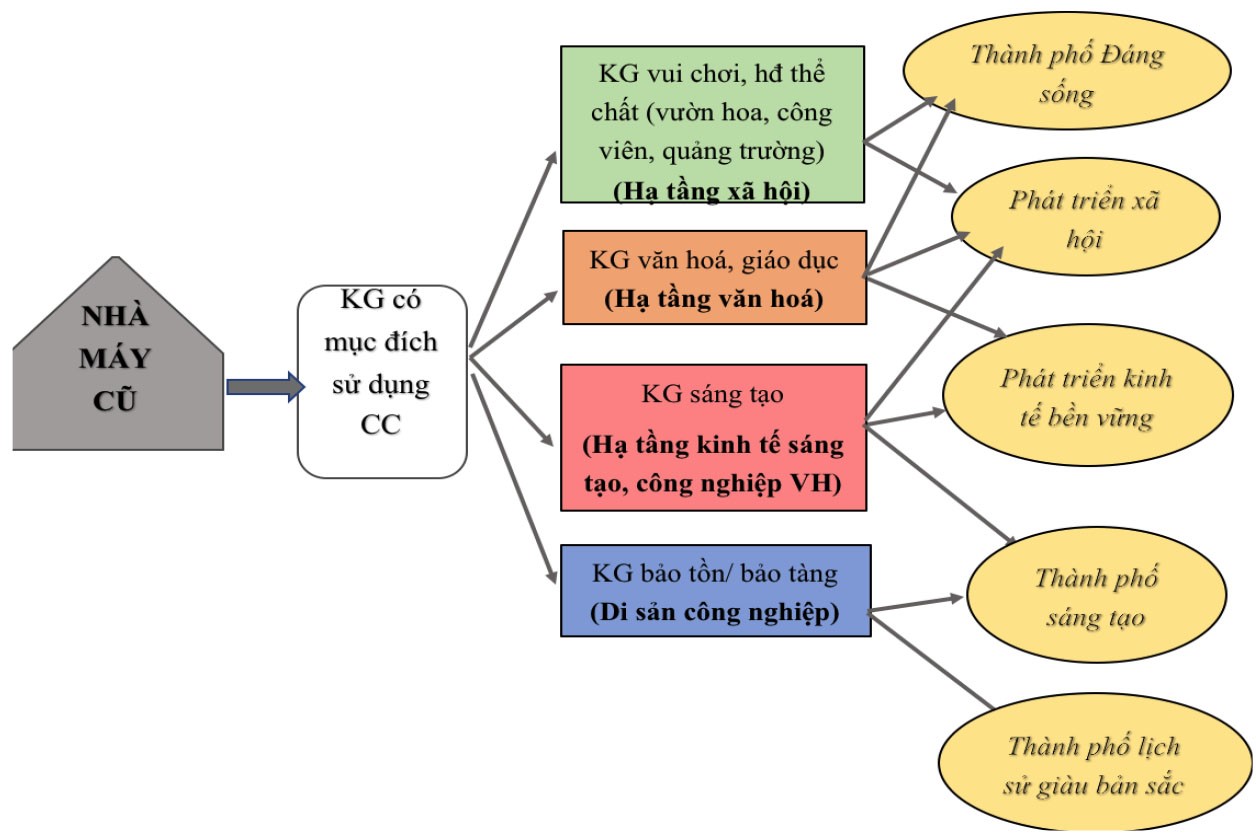
Diagram of goals and opportunities when converting old factories into public spaces (source: author)
Policy recommendations on the proposal to convert old factories into infrastructure for cultural industry should be considered in the process of adjusting the master plan for construction of Hanoi capital to 2030, with a vision to 2050.
According to the Resolution of the City Committee, cultural industry will be one of the key economic sectors of Hanoi. Like any field of development, cultural industry needs infrastructure to develop. It is a system of spaces – places necessary for the process of creating and producing new cultural values, introduced and exchanged with the domestic and international public in the same way that the production market and the exchange of goods still operate. Simply put, these are the spaces that artists, designers, creative forces, start-ups need to operate, create, and reach the public – These are cultural and creative hubs combined with public spaces.
(1) The first proposal is to define the infrastructure system of the cultural industry sector in this Hanoi Adjustment of Master plan.
The basic part of the infrastructure system of cultural industry is the network of creative cultural spaces in the Capital, ideally distributed at the level from the city level, to the district level (in the future, if this system develops to the grassroots level such as wards and residential areas, the better). This system needs a variety of types that will suit the inherent and inevitable diversity of society, creating a “cultural and creative ecosystem” that is essential for nurturing creative forces for Hanoi for a long time, over many generations. In particular, it is necessary to plan (spatially distribute) places with the function of public cultural and creative space in Master plan. Where is the land fund for these public cultural and creative spaces, it needs to be reviewed and balanced.
(2) Review of old factories on the relocation list to consider converting land use functions from industrial to cultural industrial infrastructure.
First, Hanoi needs to urgently conduct a survey, inventory and evaluation of old industrial facilities in Hanoi from the perspective of “Heritage” and “Valuable Architecture” according to the Law on Heritage and the Law on Architecture (including those who plan to relocate or not), thereby soon establishing a “List of valuable industrial architectural works” for Hanoi, to have appropriate management and exploitation facilities. Valuable industrial architectures will be very suitable for adaptive reuse solutions towards turning into public cultural and creative spaces.
In parallel, it is necessary to review the overall assessment of more than 100 old factories in the Capital according to the criteria and suitability for conversion into different creativity – culture spaces, public spaces, Social Infrastructure, to select the factories to carry out the conversion (possibly in order of different priorities) and the appropriate conversion model. With a high concentration of population and construction density in the inner city, these old factories are the last rare opportunities for social goals, including creativity – culture spaces, public spaces.
The review and consideration of converting the land fund of old factories into public spaces should be carried out at the city level, however, the implementation and implementation need the participation of district authorities. Therefore, policies related to the decentralization of management and implementation of planning need district governments to make specific action plans to develop public spaces in general and creative spaces in particular, in which, the converted old factory land fund in the locality should be considered as a potential and important source.
The conversion of old privately owned factories, joint-stock enterprises or state-owned enterprises into public utilities is one of the important obstacles hindering this transition. Therefore, it is necessary to have strong planning and construction policies, accompanied by incentive and preferential policies such as policies on priority of investment loans, tax incentives for projects converted to public works to ensure that: Converting old factories into community spaces is the most feasible and beneficial option for the parties involved.
(3) Identification of strategic projects on infrastructure of cultural industry
Consider choosing 3 to 5 old factories (or locations) to make the transition into cultural and creative spaces – public spaces; these projects should be located in the Master plan, as a basis for concretization in the QHPK and implemented thereafter. You can consider choosing: Gia Lam Railway Factory, Dong Xuan Knitting Factory, Thang Long Tobacco Factory, Hanoi Brewery … Each factory can have its own conversion plan, which is specified in the following step.
(4) It is necessary to study and clarify the content of the concept of “Infrastructure for Cultural Industry” expressed in Master plan and for future management
Naturally, this is a mixed form of land use, which has both social and economic implications. It lies between profitable functions (such as commercial housing, malls) and purely non-profit social functions (such as public schools, libraries). It has the ability to be autonomous in terms of revenue and expenditure, but cannot compete with commercial condominiums, office buildings or supermarkets; but it determines the long-term and sustainable development for the city, therefore, the city needs to prioritize the land fund for the infrastructure of cultural industry. Depending on the operating model and future exploitation, other support of the city may be needed, but the first thing to affirm is to prioritize keeping the land fund for this purpose.
(5) General inventory of land funds, wild, unused space, in urban areas (including public land, enterprise land, private land);
Review the planning and actual implementation of investment in these land funds according to the plan. If within 5 years the Developers/ land owners do not have a plan or are not eligible to implement, they shall be included in the List of incentives for the development of short-term creative cultural spaces (5-10 years). The city can publish a list of these potential spaces, and act as an intermediary connecting land managers with investors, to implement 5-10 space leases under the auspices of the state.
(6) Develop legal bases for the formation of social real estate entities
Unlike commercial real estate enterprises that invest for profit purposes, social real estate entities act as NPOs, developing real estate funds for social purposes, including cultural and creative spaces, community spaces, social housing, or other social purpose projects. Create conditions for social real estate entities to invest in the development of cultural and creative spaces on the basis of exploiting locations on the list of encouraging the development of short-term creative cultural spaces and sponsoring social real estate entities to be guaranteed stable land lease contracts for 5-10 years to implement cultural space investment projects – innovative, enough to recover the invested capital. This also helps to improve the efficiency of urban land exploitation, improve economic efficiency for landowners, and activate a creative cultural business environment. Support intermediate steps in the process of creating creative spaces.
This business model has actually appeared in Hanoi, operating quite effectively and dynamically with projects such as Hanoi Creative City, or Complex 01 Project, or 282 Factory Project. The current trend is that many young start-ups are interested and want to implement projects like this, both to have a place to practice creativity for themselves and to provide space for partners, colleagues, wards and associations.