
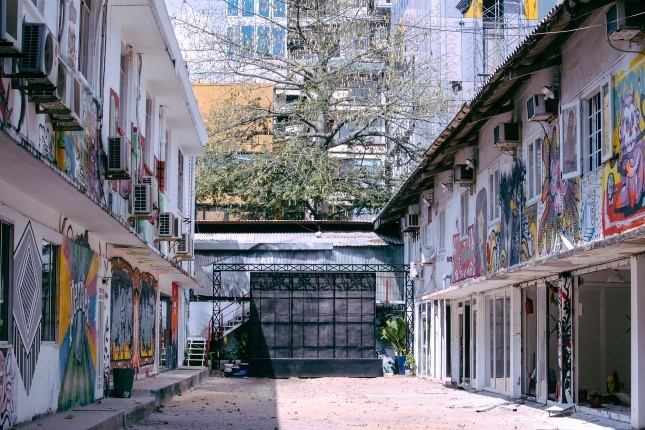
CREATIVE CITIES AND FORGOTTEN SPACES
Creative cities are currently one of the key strategies and visions for urban development. Creative cities take the creativity as the driving force for sustainable urban development. Creativity focuses on not only the field of art but also the science-technology, the solutions development for social structure, and the organization of city… The creativity associated with places and spaces is often based on the creative setting and atmosphere in the city – the “image and soul” of the city (Helbrecht, 2004 and Landry, 2006).
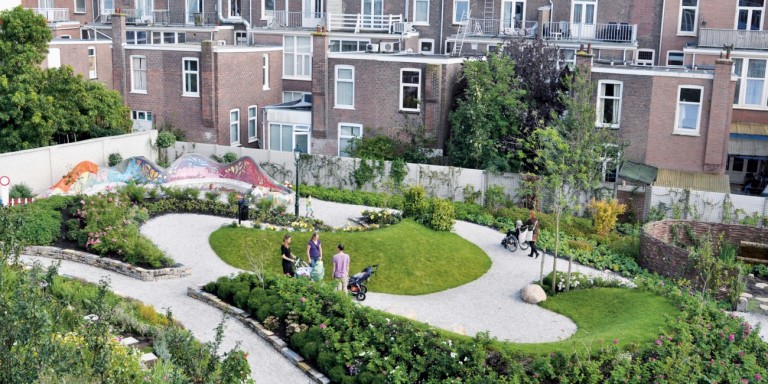
Galileistraat Project, The Hague, Netherlands
Experimental possibilities, which can be implemented in forgotten spaces in urban structures – It is a prerequisite for a creative city. Figuratively, “forgotten” is used to mean being forgotten from the consciousness of the community, from the “starving” eyes of financial investors, and from the vision of “new city” planners. Literally, they are “free spaces”, unaffected by political and market statements, and, therefore, become a source of new ideas in the creative city.
Transforming “forgotten” spaces into spaces for creativity
In the movement of rezoning cities, it is inevitable to change the use function of the space of old production facilities in the form of forced relocation or removal. A large area of land, buildings, workshops, warehouses with no specific uses now attract citizens, artists, teenagers, children … coming to create playgrounds and spaces for experimentation.
Galileistraat Community Garden Project, The Hague, Netherlands; The Tanner Springs Park project in Portland, Oregon, USA is typical of the transformation and use of “forgotten” spaces in the world. The projects all come from works and land that are rarely used. With the consent of the city government, residents called for economic resources to rent and renovate into community gardens. Projects have gradually become public spaces that meet all the basic needs of the surrounding community.
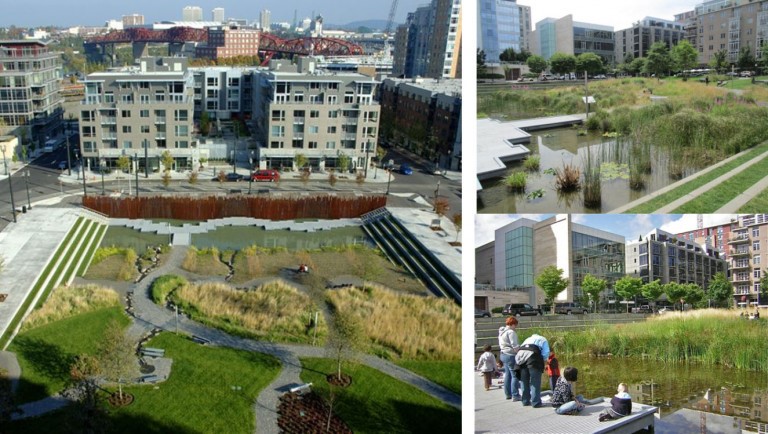
Tanner Springs Park Project, Portland, Oregon, U.S.
A typical example in Vietnam is the “Art Market” space – Zone 9, a pioneering place in the regeneration of forgotten spaces to become cultural and creative spaces in Vietnam. Shortly after its inception, Zone 9 quickly became the favorite destination and choice of young people in Hanoi. Zone 9’s space was built on top of the old pharmaceutical manufacturing facility, and was quickly transformed into an art runway and community service space. After that, other complex chains such as Zone X98, Hanoi Creative City in Hanoi; Terminal 3A in HCMC was built. Although it only exists for a certain period of time, its appearance has suddenly created a series of economic stories, architecture, planning, or the interaction between cultural and artistic creation and life. So far, Vietnam has more than 200 creative hubs inspired by the conversion of old land into creative spaces, such as 282 Design, Public Art Phuc Tan; children’s playground…
Changing views of “forgotten” spaces in urban areas
The above examples show the experimentation of transforming forgotten spaces or lands between organized urban areas, which seem to have certain potentials to trigger the uses of creative individuals. And accordingly, the municipality actually benefits from forgotten areas and unused buildings. The article aims at how to look at forgotten areas in urban areas that can provide adaptability for the creative city in the future.
The forgotten spaces from the “territorial” perspective defined by postmodernist planners are:
- Downtown spaces, residential areas, and entertainment areas are examples of territorial spaces;
- Forgotten lands in urban areas are non-territorial spaces.
Territory is understood as “The creation of meaning in social spaces through the creation of intentional connections” (Brown & Lunt, 2002). The former Zone 9, or 3A Station buildings were territorial spaces that declined or were forgotten due to functional transformation; when it is new, “non-territorial” and used for experimental art. The process of “demobilizing” the territory is destabilization and gradually eliminating the meaning of stability.
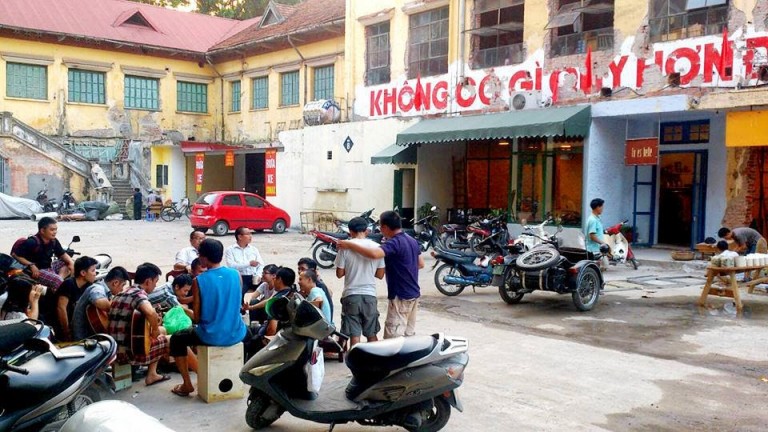
“Art Market”_Zone 9 in operation
Sociologist Richard Sennetts (1970) stated that such spaces and the difference between the mentioned qualities of space in the city are necessary for the development of the individual. He emphasized disorder in unplanned areas in urban development as a prerequisite for individual development in the city.
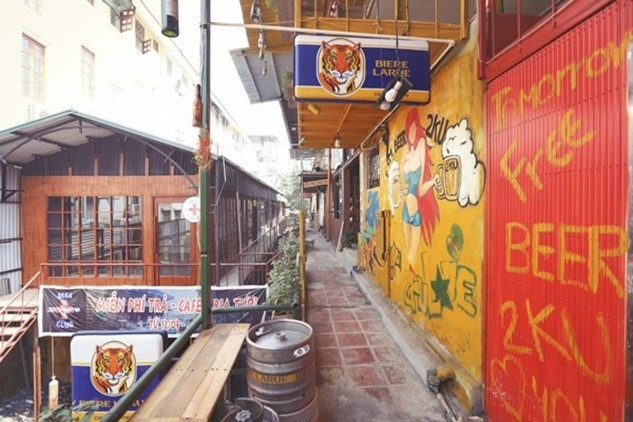
Zone X93
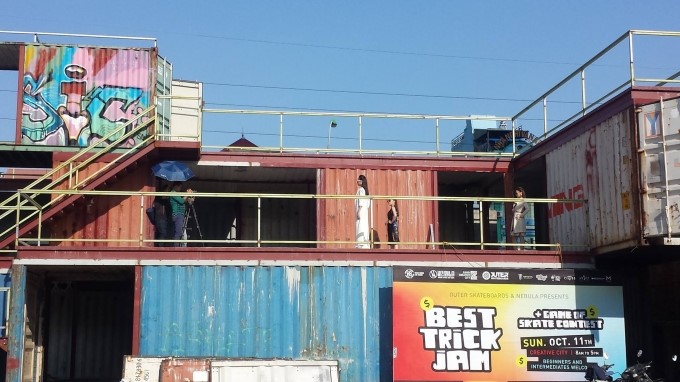
Hanoi Creative City
3A Station
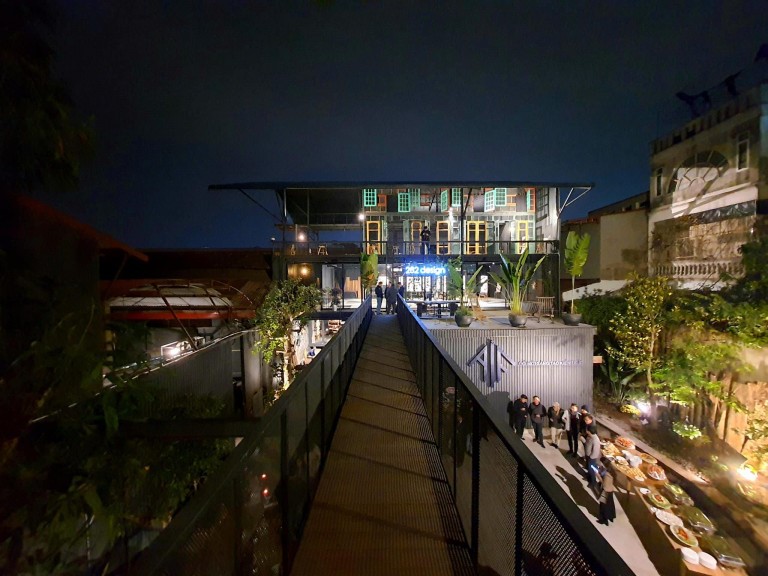
282 Design
Planning the test space
Urban development is characterized by cycles and stages of transformation of territorial and non-territorial spaces within the urban structure. Non-territorial areas are often the dilemmas of urban planning. Therefore, the old urban planning process was mainly the development of territorial spaces, the closure of non-territorial spaces. The general idea over the past 10 years has been to regenerate and find new uses for these areas. This is a good strategy to improve the urban landscape and support the development of non-territorial spaces in the urban structure.
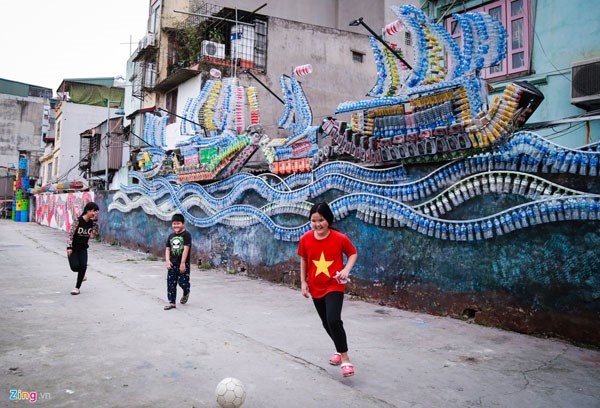
Public Art Phuc Tan
Bey (1991) once argued that new and unexpected things stem from derelict qualities in areas constrained by the concept of “temporary autonomy.” Open, non-territorial spaces should be viewed as valuable resources despite the fact that they are being considered “worthless” (Lynch, 1991). This article advocates for non-territorial venues and areas for “occupation” free artists, cultural activists, and even surrounding residents to use as playgrounds, operating spaces for various uses. However, this proposal will more or less affect conventional urban planning and will have the potential for vandalism or graffiti. This isn’t exactly ominous, and should be seen as a sign of a creative process.
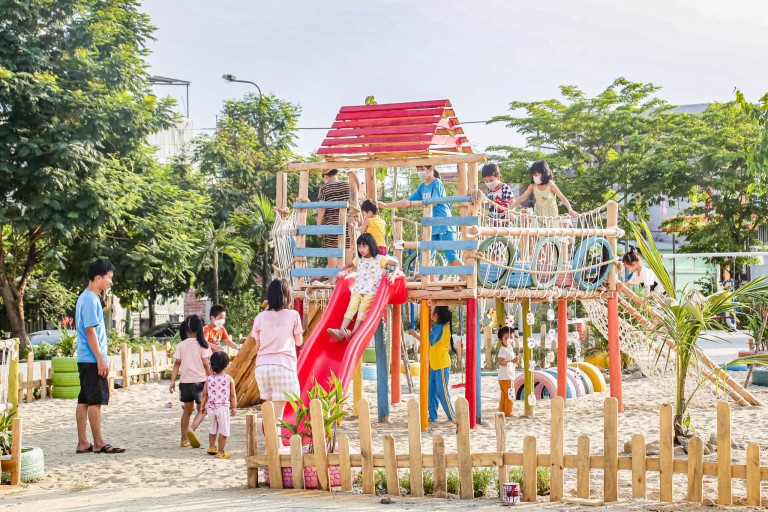
Community playground project for children (Da Nang). Source: CELC_Trường Da Nang University of Architecture
The process of urban use and creation with these spaces is a serious test of what the people want when using those areas. For planning, this needs a transformation of understanding and the opening of spatial structures for innovation. Planning for test spaces is necessary. Urban planning in general or more specifically social interaction network needs more interaction and more research to be able to well manage the forgotten or non-territorial spaces.