
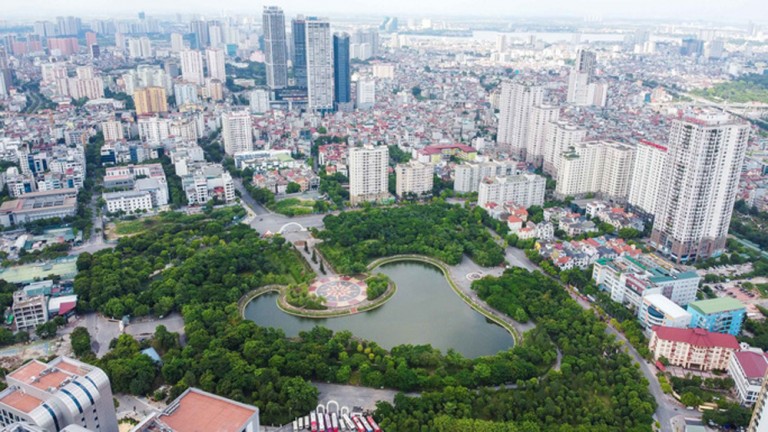
ECOLOGICAL LANDSCAPE DEVELOPMENT FOR HANOI URBAN AREA
To build a sustainable future, eco-urban development is the goal that many countries aim to. Hanoi city has enough conditions to develop following the criteria of green urban, ecological urban thanks to the large area of trees, water surface, and the number of relics. The balance between conservation and new development has also been considered.
Hanoi city is continuing to develop following the criteria of green urban, ecological urban thanks to the large area of trees and water surface.
Converging many sustainable development factors
In the master plan for the construction of Hanoi Capital to 2030 with a vision to 2050, approved by the Prime Minister in Decision No. 1259/QD-TTg dated 26-7-2011, Hanoi is determined to be an environmentally sustainable “green” city; an ecological city with the harmony of nature – society – human factors; a city that balances conservation and new development. According to Decision No. 1259/QD-TTg, existing district and towns develop under the model of low-density ecological urban areas.
At the Seventh Conference, the Party Committee of Hanoi (XVII session) took place on February 23 and 24, the Staff Committee of the City People’s Committee submitted a report on the assessment of the Master Plan for the Construction of the Capital to determine the planning orientations in accordance with practice, identify limitations, disadvantages. Also a number of orientations which adjust the Master Plan for the construction of the Capital with the goal of taking people as the center, the quality of life as the basic are proposed. The submission stated the orientation of spatial development in central urban areas, satellite cities, ecological urban areas, towns and rural development areas (green corridor areas).
Regarding the orientation of ecological urban development, Architect Tran Huy Anh, Standing Member of the Hanoi Association of Architects, said that Hanoi converges many favorable factors for sustainable green urban development. It is a natural advantage including a dense river and lake system, unique and rich soil with the complete agricultural areas. The natural advantages create th space to transform and regenerate excess material in the process of urbanization.
And Architect Do Hau, Vice Chairman of the Vietnam Urban Development Planning Association stated: “Ecological urban development is very necessary for the sustainable urban development. However, currently, the criteria for building an ecological city have not been stated in the system of legal documents in our country. Therefore, it is necessary to have in-depth studies of ecological cities with specific criteria. The eco-town model in each region has a different solution. For Hanoi Capital, the development of eco-cities – eco-towns must follow the criteria of sustainable development in the conditions of the Capital”.
Prioritizing the development of green urban infrastructure
Also according to Do Hau, to form eco-towns as a driving force for the development of rural areas, it is necessary to prioritize the development of green urban infrastructure with green transport systems, save energy, reduce emissions, use renewable energy, use clean materials technology. For Hanoi Capital, the inclusion of green development content and green criteria in the planning, design and construction of urban infrastructure is essential.
Recently, many urban areas built in Hanoi are called ecological urban or green urban areas. Many urban projects in the process of formation also aim at the criteria with priority in arranging area for water surface, trees as well as organizing good community space. Looking at this development direction from a professional perspective, Architect Tran Nam, Hanoi University of Civil Engineering said that the urban ecological landscape is not just trees and water surface but a system with interconnectedness. In new urban areas, especially those with natural conditions, it is being prioritized to establish a system of trees and water surface. This is a very good thing but it should be noted so that this system is not broken and there must be the connectivity to create a community space and a really better ecosystem.
Also according to Architect Tran Nam, Hanoi’s ecological landscape can be divided into 2 areas, including the old inner suburbs area (in Belt 1, 2) and new expanded development areas after Belt 2, 3, 4). With the old inner city areas, it is recommended to focus on embellishing and improving the efficiency of use of existing ecological landscapes such as rivers, lakes, flower gardens, parks … In the expanded area, besides preserving the green belt idea, the government should have planning orientations in advance of parks, trees, water surface along with ecological buffer zones of those landscapes before implementing other plans.
Developing and improving the efficiency of urban ecological landscapes is an important criterion towards building a sustainable urban development. With the orientation of development following the criteria of green urban areas, ecological urban areas in the near future and the preservation of existing ecological landscape values, the balance of conservation and development, the quality of life of the people of the Capital will certainly improve.