

PLANNING TO RENOVATE AN OLD APARTMENT COMPLEX IN HANOI
Housing areas account for the largest proportion of urban structures. Including a large volume of old apartment complexes. In fact, in Hanoi, many old apartment complexes, due to their long existence, are not regularly and properly maintained, so they are technically degraded and do not meet the needs of modern life of people. There are even many old apartment buildings seriously deteriorated, showing a risk to the safety of residents.
The issue of renovating old apartment complexes and old apartment buildings in Hanoi has been concerned for many years by the city government, construction investment enterprises and experts with many policies issued and with many proposed implementation methods. However, in reality, the success in renovating old apartment complexes in Hanoi is limited. Only a handful of old condominiums have been renovated. It is only local intervention, lack of comprehensive, synchronous solutions along with direct participation and practical effectiveness of the people.
That shows that the planning for the renovation of old apartment complexes in Hanoi is an urgent but complex issue. Therefore, it is necessary to continue to study at the same time many professional and policy issues to effectively implement in practice the renovation of old apartment complexes in Hanoi. The article focuses on key professional issues such as: Apartment planning model in Hanoi; assess the current situation of industrial zones in Hanoi; on that basis, try to propose solutions to the planning and renovation of Giang Vo old apartment complexes.
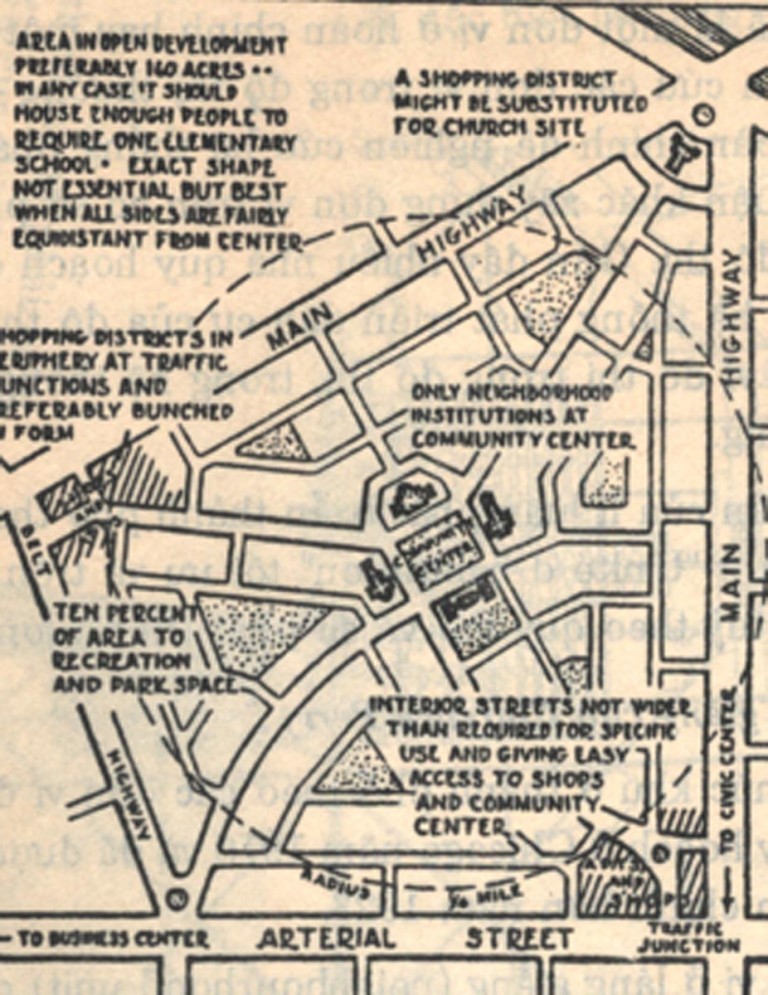
- Perry’s neighborhood unit
Old apartment complex planning model in Hanoi
Old apartment complexes in Hanoi or Collective Zone by common name is derived from the Neighborhood Unit theory proposed by C. Perry in the US in the mid-1920s. Later, many countries referred to the Neighborhood Unit as the Housing Sub-division. In theory, the housing sub-division is built synchronously according to reasonable functionalism, meeting the basic social and daily living needs of residents. Accordingly, level 1 high schools (grassroots level) and public services with flower gardens – community living spaces are the basis for calculating the population size and land of a housing sub-division in the municipality. The reasonable size of a level 1 high school is 1000 students, which is equivalent to between 5000 and 6000 inhabitants of a Housing Sub-district which is considered reasonable [2].
The housing sub-division changed the previous concept of housing planning and architecture and had a widespread influence on the world in the following years.
In Hanoi, the housing sub-division is applied based on the design of socialist countries. In 1958, for the first time, the concept of housing and collective housing with low-rise housing areas (1-2 floors) appeared for workers, such as the housing areas of Ham Tu Quan, Luong Yen, An Duong. In 1960, for the first time, the model of synchronous and complete housing sub-divisions was built in Hanoi, the scale is about 20ha for 6,000 people with apartments from 2 to 5 floors high, typically Kim Lien Collective Area, until the 1980s and early 1990s, a series of housing sub-divisions were built, such as Giang Vo, Trung Tu, Hao Nam, Thanh Cong, Thanh Xuan,…
It can be affirmed that the model of housing sub-division at that time was a new form of residence with successes in transferring construction techniques and technologies, applying design principles in the direction of industry, construction materials, modern structures. The housing sub-division creates a new and modern architectural face and is the happiness and pride of Hanoi people when being assigned apartments.
Housing architecture in Kim Lien Collective House
Assessing the current situation of old apartment complexes in Hanoi
- Current status of old apartment complexes
The old apartment complexes in Hanoi was built from the late 1950s to the late 1980s, mainly in the historic inner city area of various sizes and is currently deteriorating to varying degrees.
According to the data of the Hanoi Department of Construction, as of 2021, there are 76 old apartment complexes in Hanoi, of which 34 complexes are 2 hectares or more and 42 complexes are under 2 hectares, with the number of old apartment buildings is 1,273 out of the total number of old apartments in the whole city is 1,579 houses. In addition, there are 306 independent former condominiums. Old apartment buildings with a common scale of 2 to 5 floors are built with brick wall structures (856 buildings), panel floors or column-beam frame structures (145 buildings), reinforced concrete (193 buildings), concrete with small slabs and large panels (273 buildings). The old apartment buildings are concentrated mainly in 4 urban districts, in the limited development area with the number of 1062/1,579 houses. In which, Ba Dinh district has 211 houses, Hoan Kiem district has 120 houses, Dong Da district has 438 houses and Hai Ba Truong district has 293 houses [9].
- About the current status of old apartment complexes planning
The total planning ground of old apartment complexes, especially those previously designed and built synchronously, has now been changed due to the large population increase along with the emergence of many new functions to meet the needs of modern life in the market economy. The buildings have the 1st floor expended for services with many diverse forms, interspersed with new apartments, empty space, trees, water surface (if any) is narrowed,…
- About the current state of construction engineering
Most of the old condominiums are deteriorating, many of which are serious (level D). According to data of the Hanoi Institute for Socio-Economic Development: Currently, in Hanoi, there are 200 old apartment buildings assessed as danger at level C, 137 buildings at grade B and 7 buildings in level D. In general, The level of deterioration of construction techniques of the building is expressed in the forms of: Inclination, subsidence, concrete cracking, reinforced rust and moldy moss, leakage. [10]
- About the current state of architecture
It can be seen that, due to expanding the buildings in an unorganized way, the architecture of most old apartment buildings is distorted in a negative way both in terms of shape, façade, color and architectural details.
- Policy
Facing the deteriorating situation of the old apartment building in Hanoi, from 2005, the city issued Resolution No. 07/2005/NQ-HDND. This is considered the first policy of the city on the issue of renovating old apartment complexes in Hanoi.
Since then, many legal documents related to the renovation of industrial zones in Hanoi have been issued by the Central Government and the City. In particular, most recently, on March 28, 2021, at a meeting with the Prime Minister, Hanoi proposed that the Government allow the city to study and synchronously build a specific policy framework on renovating and rebuilding old apartments according to 3 models:
- Old apartment complexes, making detailed planning plans;
- Group of old apartments, making total premises;
- Independent old apartment buildings, researching methods of gathering and resettlement on site in wards and districts.
At the same time, the City People’s Committee proposed the basic contents to implement the specific policy framework on renovating and rebuilding old apartment complexes and old apartments in Hanoi as well as other related contents. These are policies: For stakeholders, especially the people who are the owners; on the order of project implementation; on criteria for selecting old apartments for projecting, including separate regulations for old grade D apartments; on investor selection; on land acquisition; on compensation mechanisms; Regarding the financial support mechanism for the project; [10]
- About old apartment complexes renovation planning
With the policy of socialization, in 2016, the city selected 19 investors, self-funded the detailed planning study of 22 industrial zones. For the purpose of financial balance when investing, in projects, population indicators, high floors exceed the provisions of the general planning and regulations on management of high-rise buildings in the historical inner city. By 2021, using the budget capital, the city has researched and applied mechanisms and policies to make detailed planning according to 3 models: old apartment complexes, Old apartment group and independent old apartments as mentioned above.
- On the implementation of projects to renovate and rebuild old apartment buildings
Up to now, according to a report by the Hanoi Department of Construction, there have been 18 completed projects, including 2 old apartment buildings in dangerous grade D condition and 14 projects under implementation. The sources of capital mobilized to implement the projects are quite diverse: Budget capital, combined with city support capital and non-budget capital.
- Evaluation
The old apartment complexes model in Hanoi has certain values for Hanoi’s urban structure, which needs to be fully studied and evaluated in terms of planning, architecture, environment and culture of residence.
However, the survey results show that the situation of distortion in old apartment complexes planning, deterioration in construction techniques and architecture of old apartment buildings in Hanoi is serious. In addition, the implementation of projects that are delayed and do not achieve the expected results is due to many objective and subjective reasons:
First of all, the objective cause is: Over time, the old apartment complexes deteriorate technically. The population is growing rapidly, especially in the context of the market economy, expanding, expanding residential space, encroaching on public space, especially on the 1st floor to open diverse shops and services. As a result, the density of construction in the old apartment complexes on average doubled and the number of residents increased by about 1.5 times. That is the main reason for the distortion of the original planning structure of the old apartment complexes in Hanoi, and at the same time creates pressure to overload the technical and social infrastructure system in the IPs.
On the other hand, the subjective cause is: The demographic number of families living in apartments increases, even generations live together in an originally assigned apartment, while there are no conditions to change accommodation. The pressure of residential area is a lifesaver that, despite regulations, distorts the original architectural form. Besides, financial resources are limited, so it is necessary to mobilize socialization resources. And the difficulty here is to balance the interests between households and investors. On the other hand, the legal documents related to the renovation of old apartment complexes and old apartment buildings are not complete and synchronous to be able to quickly and effectively promote the renovation of old apartment complexes in Hanoi, such as: Regulations on management of planning and architecture of high-rise buildings in the historic inner city area, where there are many old apartment complexes controlling the height and density of construction of renovated or newly built buildings, it is not attractive for private investors to participate in the renovation of old apartment complexes in Hanoi. [10]
Planning to renovate Giang Vo apartment compplex, Hanoi
In general, in the world of professional intervention for urban old apartment complexes, there are 3 common trends:
- The first one is to renovate old apartment complexes with value in terms of architecture, urbanity and local resident culture. Intervention solutions often follow the trend of adaptation, improving the quality of life of residents to suit modern needs and avoiding heavy demolition and non-large-scale resettlement;
- The second one is that new construction on old apartment complexes location is not suitable for modern needs;
- The third one is to combine the two trends of renovation and new construction and depending on the specific case of old apartment complexes, apply accordingly.
The reason for choosing Giang Vo old apartment complexes for renovation research, because through the results of the survey and analysis of the current situation and comparison with other old apartment complexes in Hanoi, shows:
The planning structure of Giang Vo old apartment complexes still has certain values, reflecting the typical superiority of the housing sub-division model in Hanoi. It is a balance of groups of houses, reasonable transport networks, lakes and green spaces. It is the water surface and greenery that are necessary for tropical climate conditions, and at the same time are the components that create the characteristic values of architecture and landscape of Giang Vo old apartment complexes.
In fact, in the process of development, due to the impact of the market economy, many new and mixed functions appear, making the planning structure of Giang Vo Industrial Park strongly shifting from the model of independent, closed housing sub-divisions to an open model towards urbanization instead of just roads as before to link favorably with other components of the The city while preserving the structure of housing groups – It is Giang Vo street with the tendency to focus mainly on commercial functions, Ngoc Khanh street is a service, hotel, Kim Ma street, office and Nui Truc street focuses on daily services to serve people on site. In addition, there are small streets, mixed functions, creating bustle and liveliness in Giang Vo old apartment complexes.
Thus, based on the results of the survey, analysis and assessment of the situation, when researching and proposing the renovation plan of Giang Vo Industrial Park, intervention solutions can be applied in the direction of combining renovation and new construction. In particular, note respect for planning structures, landscape features, water surface and resident culture that have been shaped as valuable urban heritages. At the same time, new planning and architectural interventions should be directed towards adapting to tropical climatic conditions and cultural characteristics of residence that have shaped over time.
Tropical factors are reflected in the exploitation and use of water surfaces and trees in the form of open spaces, creating a basis for organizing architectural spaces, and at the same time contributing to improving the efficiency of natural ventilation in old apartment complexes.
The cultural element of residence is reflected in the lifestyle of the community. It is an outdoor lifestyle according to diverse social groups with flexible use of space, preferring small percentage of public spaces with greenery.