
QUALITY PLANNING IS NEEDED TO BUILD A WORTHY CAPITAL
In 2022, Hanoi will implement many important tasks in the field of planning to build a “green – smart – modern” city.
It can be said that a particularly important factor changing the urban appearance of Hanoi in the coming period is that the city is making adjustments to the master plan for the construction of Hanoi Capital to 2030 and a vision to 2050.
Adapted to meet development requirements
The general plan for the construction of the Capital to 2030 and the vision to 2050 was approved by the Prime Minister in Decision No. 1259/QD-TTg dated 26/7/2011 (QHC1259). According to Director of Hanoi Department of Planning and Architecture, Nguyen Truc Anh, after 10 years of implementing QHC1259, many approved urban subdivision and general planning projects for district construction have met the requirements for construction investment and urban management in the city, create momentum for socio-economic development of the Capital. Land planning, construction and management, urban management are strengthened. The appearance of the Capital has changed a lot, Hanoi urban area has been gradually modernized and enhanced the position of the Capital nationwide, regionally and internationally.
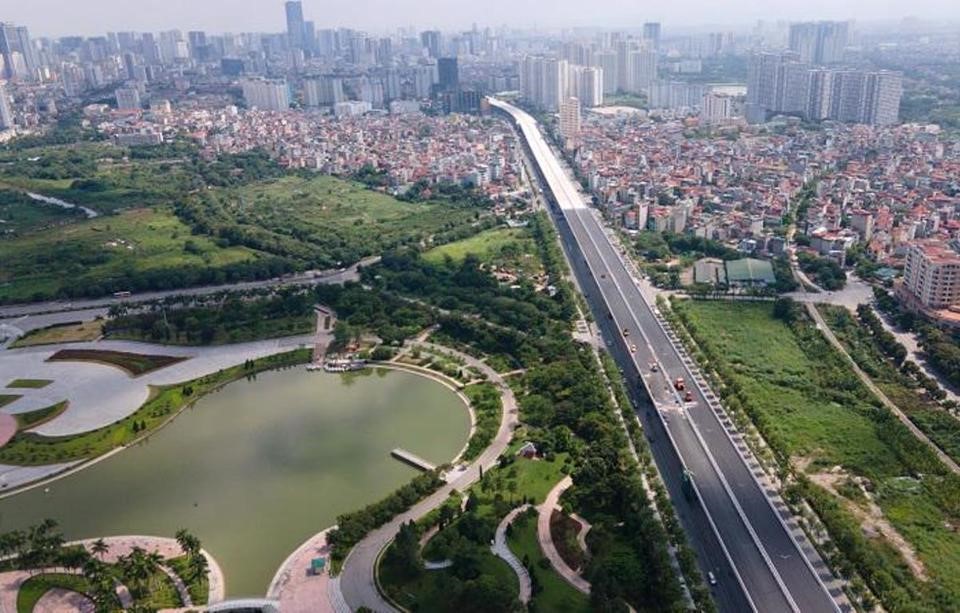
A corner of Hanoi. Photo: Pham Hung
In the central urban area, the urban appearance has changed positively, the urban landscape has been enhanced; forming a number of large urban areas completed from master structure planning, spatial architecture, landscape details and closed social services. Some suburban districts have a rapid urbanization rate. Technical infrastructure, social infrastructure are the focus for investment, upgrading and being gradually completed;
However, the leaders of the Hanoi Department of Planning and Investment also recognized that the process of implementing QHC1259 also arose many problems so far that it was necessary to adjust. At the same time, a number of legal regulations related to urban planning have been amended and newly promulgated. In addition, there have been adjustments to the socio-economic development strategy at the national and regional levels… affecting the nature, functions and development orientation of the Capital.
For example, according to the orientation of QHC1259, the controlled population density by 2020 is 2,188 people / km2, of which in the central area of the Capital is 5,012 people / km2, but so far it has reached 9,570 people / km2.
In terms of population size, according to the orientation of QHC1259, the population of the whole city is expected to be about 7.3 – 7.9 million people by 2020, the urbanization rate is 58 – 60%. However, by 2020, the population size has exceeded the expectation when the whole city reached 8.24 million people, while the new urbanization rate reached about 49.3%. The management and control of the population in the central urban area and the expansion of the inner city face many difficulties.
At the same time, the urban cluster development model with 5 planned satellite cities has almost no results yet. Therefore, the basic load reduction with some functions that are being over-pent up in the central municipality has not been implemented.
In particular, the creation of a “green corridor” area with a rate of 70% of the city’s land fund has created limits on the urban development process…
Therefore, in order to meet the sustainable urban development goals of Hanoi City, ensure a long-term strategic vision, synchronously implement solutions to solve urban problems such as population, infrastructure, housing, environment … it is necessary to adjust the overall of the General Plan for the Construction of the Capital to 2030, with a vision to 2050.
Choosing good advice for quality planning
Director of Hanoi Institute of Construction Planning, Luu Quang Huy said that the orientation to adjust the upcoming Capital Construction General Plan includes some main contents such as: Limiting population growth in the inner city, in which 4 old urban districts continue to reduce population, expanding inner city without increasing the population, adding population to the area in the north of the Red River and the East of the 4th Ring Road to exploit land use more efficiently.
Notably, the city will study the possibility of developing a “city within a city” model in the Northern (Dong Anh, Me Linh, Soc Son); the West (Hoa Lac new city) and the establishment of several new towns located in satellite towns.
In addition, the Red River axis will be focused on exploiting as a central green axis, in the direction of balanced development of space on both banks of the river and studying the possibility of developing the northern area of the Red River into a modern and synchronous urban area. Districts expected to become districts in the period of 2021 – 2025 are studied for infrastructure development, associated with green and sustainable urban areas along the 2 sides of Ring Road 4, creating transitional space between urban and rural areas.
Satellite cities are reviewed to complete the model and development roadmap to have a plan to focus investment resources in order of priority. Research on adjusting the synchronous structure of urban transport infrastructure, studying the possibility of arranging the 2nd airport for the Hanoi Capital Region…
Chairman of the Vietnam Urban Planning and Development Association, Tran Ngoc Chinh said that, as a special city and the capital of the country, it is very necessary to review and evaluate the general planning in the past 10 years. To make strategic forecasts on the sector, socio-economy, both as a direction for urban construction and development planning and as a foundation for integration into the Capital Plan in the period of 2021 – 2030, with a vision to 2050. However, in addition to implementing orientation and target programs, it is necessary to have a different approach from other cities, which is to have good advice to have good planning quality.
“The city should organize the contest, have a good consulting option to work with the city to build planning ideas, fully exploit resources, nature, people, build a capital worthy of the pride of the whole country” – Mr. Tran Ngoc Chinh stated.
It can be said that the people are looking forward to new ideas so that the project for adjusting the general planning for the construction of the Capital is really quality, which is the basis for materializing the goal of building and developing the Capital worthy of its position and role, by 2030; Hanoi has become a “green – smart – modern” city, developing dynamically, effectively, competitively in the region and internationally…
Hanoi’s urban structure is in a cluster model consisting of 1 central urban area, 5 satellite cities, ecological cities, towns and rural areas; is connected by a ring road system that combines radial axes. This is a model that has been strictly calculated and in line with the reality of Hanoi’s development requirements. The current problem is that the city needs to have roadmap to build satellite cities for forming new cities. The view of building a new city in the northern area of the Red River is still inadequate, not in line with the view of developing a city and the Red River area as the central green axis.