
TRADITIONAL VILLAGE GATE – THE UNIQUE ARCHITECTURE FEATURES
The village gate is a type of architecture and culture that was very popular in the delta and Northern midlands in the old day. The village gate appeared very early on that it has associated with the formation and development of the village. In the beginning, they were probably just primitive gates built of bamboo. People added some thorn vines to prevent the villagers and their cattle from wild animals. Later, with the development, people used laterites, together with bricks, tiles, lime and mortar and other materials in rural construction. The village gate was also built more sustainably and carried architectural, artistic values.
In the past, Hanoi had many village gates. There were street gates in the area of “36 streets of Hanoi.” Nowadays, Thuy Khue is the street with the most village gates in the city. In the western region of Hanoi (previously known as Ha Tay), almost every village has an entrance. Some areas have 2 or 3 gates built on the roads leading to the village. There are also gates leading from village streets to the hamlet. The gates are called the hamlet gate. However, many old gates were gone over time due to war and many other factors.
In terms of architecture, village gates are ancient architectural works that mix between communal architecture and traditional features. The village gate usually has four architectural parts that connect and form sustainability, harmony, and aesthetic value.
The gate is built at the entrance of the village. There is the arch, essential part of the gate, is on the top of the gate. It is composed of curved arches design. Depending on the location and conditions of each village, the arches are big or small, yet they are harmonious structure and ensure convenient travel for the villager.

The arch of the gate.
Two columns in two sides support the arch. The columns are decorated with very elaborate sculptures. The part closes to the road surface is the foot of the column. The body of the column is to carve the couplets. Above the body of the column is the neck. The top of the column is the head pillar. There is a rectangle box attached to the columns called a lantern. On the lantern, there are many different decorations. Some villages will carve gardenia fruit, or a Nghe (a fictional creature with a lion-like head, a long tail and a dog-like body).
On the gate, people embossed with stylized lath-shaped flowers and the big letters of the village’s name. Besides, there are some villages embossed words that contain concise meanings that present the motto of living.
On the top of the gate is the tiled roof to protect the gate surface and shade the passers-by from the glare of the sun. With the large gates, there is a gazebo with two or three layers of rooves following the ancient communal house or pagoda architecture.
Typically, the gate has only one main door; however, in many villages. In two sides of the main entrance are two smaller doors. People decorated them in harmony with the main entrance, which forms a unified architecture, look like the 3-door gate of pagodas.
Some other villages design the gate having the house roof at the top and the main entrance under the roof, such as Mong Phu gate in Duong Lam ancient village, Lai Xa gate in Hoai Duc District, Thach Than gate in Quoc Oai District. The acorns are covered on both ends of the roof. Mong Phu village gate, built during the reign of Le Trung Hung, is one of the first village gates in the region.
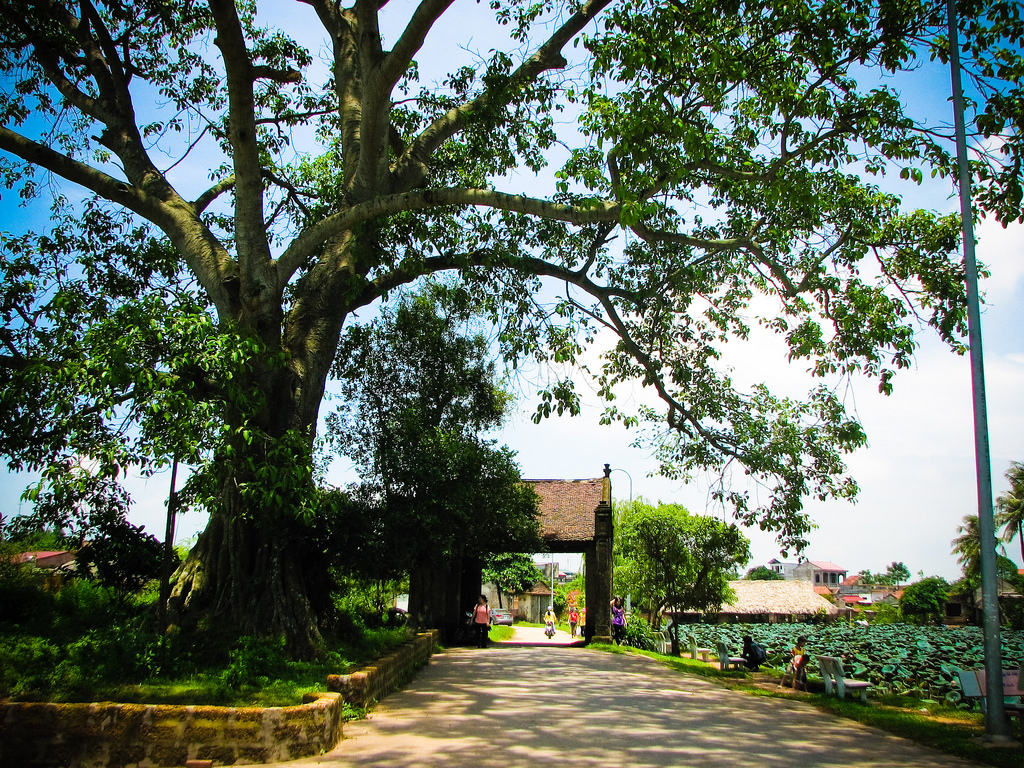
Village gate symbolizes Duong Lam village culture.
The old village gate was built with bricks and mortar mixed with molasses to create a strong structure. People used to use this mixture for roofing tiles. Many villages in the midlands have gates built of laterite. Such gates are the traditional features of Xu Doai like the gate of Chi Quan and Van Loi in Thach That, the gate of Ngo Sai village in Quoc Oai, are some typical examples.
The old village gate is very diverse in styles and materials. They have existed for hundreds of years and are considered valuable architectural and cultural works.
In the past, the village gate was built to protect the village’s security. Therefore, many village gates were designed with doors made of solid ironwood. It has a closed and open patrol at a specified time. In some villages, on both sides of the gate, there are deep creeks like moats. Inside are bamboo rows by the pond like a rampart, creating both landscape and feng-shui of the village. Near the village gate, there are small corners, not for worship, but for the patrol team. By the village gate in some localities, a greenstone dog is sitting on the ground by rock piles. People believed that the stone dogs keep the peace for the villages and protect everyone from unlucky things. When there was an enemy, the village gate became a stronghold.
Besides, the village gate has the meaning of protecting and promoting cultural and spiritual values having been through many generations. The big letters carved and embossed in many village gates has spoken itself.
The Uoc Le village gate, built in the Mac dynasty, is one of the oldest gates to this day. On the gate are three words “Uoc Le Mon” ( Uoc Le Village Gate). The words ‘Uoc Le’ is not only the name of the village but also present the Confucian philosophy adopted by the villagers. “Uoc” and “Le” are the words from Confucius, which means that if you want to be master, you must rely on culture; then if you have already learned them all, you must be modest. This thought is a necessity of a highly gifted learner. It’s on the gate to remind people to always study for achieving the cultural values. It also tells people to be modest. Such a meaningful name!
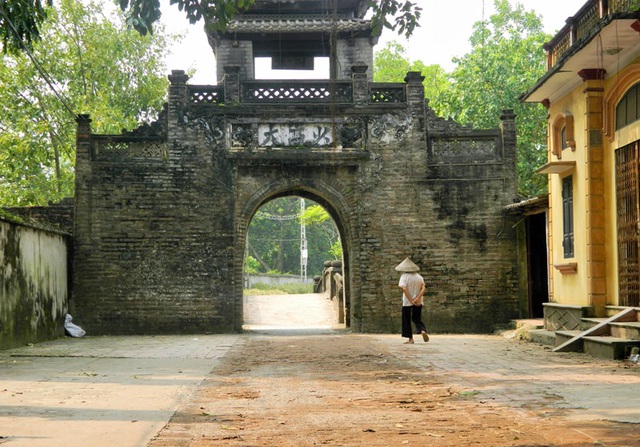
The gate of Uom Le village contains spiritual and cultural value. It is one of the most beautiful village gates remaining today.
On the back of the Uoc Le village gate and some other the villages, there are the words “Thieu Cao Dai”. These three words are an old story in Han Shu (Book of Han) which talk about a Chinese mandarin named Vu Dinh Quoc. When he returned to his hometown, he saw that his children and grandchildren were building a house, so he told them to make the gate a little high (meaning Thieu Cao Dai). He wished that his children and grandchildren would prosper. And a bigger and higher entrance will welcome them home. The old legend was carved on the gate to remind the villagers who often go back and forth every day to study diligently to have goodwill to succeed in life.
There are also village gates engraved the three words “Nhan Vi My”, which means that a village with such virtue is an excellent place to live, choosing a place like that to settle down is a wise person. The concept of virtue and humanity imbued in the choosing residential land process is also creating the social value of the village.
The gate of Phung Xa village in My Duc emphasizes loyalty and integrity with the two words “Trung Chinh.” Some other villages use three words “Truc Dao Hanh” which imply that people must walk on the righteous path. The gate of Mong Phu village in Son Tay stated a philosophy with inscriptions “Thế hữu hưng nghi đại”, which means that to be flourishing, one needs to adapt. This moral is so true and important in life.
The inscriptions on the village gate also show the tradition, identity and character of the village. The gate of Van Phuc village in Ha Dong has its front side appeared the words “Phụng Nghinh Lộ.”. This phrase meant to promote welcoming the great guests and elders is the pride of the village. The back of the gate has the words that have faded with the years: “Khuyển vệ kê minh, cơ thanh viễn cận ” that means early in the morning, there is a sound of working near and far. The sound here is the click of the silk weaving looms. That sound represents the prosperity of the old Van Phuc which now has become a famous craft village. “My Tuc Kha Gia” are the words on the gate of Ha Tri village in Ha Dong. They emphasize the nice customs and the wish for the village’s traditions still living on. Some villages hold their contract in high regard. So, on the village’s gate write two words “Thượng Khoán,” which remind the villagers to comply and respect the village’s contract). Some towns, for example, Te Qua village in Thanh Oai, express their wishes of good weather through four words “Phong Vân Bảo Hộ”.
According to the book “Old and present Hanoi village gate” (by Vu Kiem Ninh – Folk Art Association editor, Culture and Information Publishing House), all the village gate in Hanoi have their own stories. Tuong Mai village gate is located on Ke Mo land related to General Tran Khat Chan of the Tran Dynasty. Dong Ngac village gate was associated with traditional bamboo weaving and “Gio Chem, Nem Ve” (spring roll). Trung Nha village has a handicraft of making paper which was only used by the King. Trung Kinh village has a profession of making black incense. Cham Bau village (Kim Chung, Dong Anh) has the custom of worshipping Princess Tien Dung. Dai Tu village has the tradition of raising children, so dedicated to the adoption that the King bestows four words “Đại Từ Nghĩa Dân”. Although Nguyet Anh village has 11 academicians, there is still a story “The borrowed Trạng Nguyên.” (Trạng Nguyên means the first doctoral candidate.)
The village gate has a deep attachment to the ancients. It expresses the spirituality of love for the village. Legend has it that Luong Van Can is one of the founders of the Dong Kinh Nghia Thuc movement (1907). He is from Nhi Khe village, Thuong Tin district. From then on, on the Nhị Khê village gate carve four words “Như kiến đại tân” (welcome honoured guests). Whenever coming back hometown, Luong Van Can walk home from the village gate. However, it was customary for the villager to stop at Nguyen Trai temple (called Ong Khai Quoc temple with a stele) then getting off the vehicle to walk past the temple. The love for the homeland like Mr Luong and Nhi Khe villagers is very respectable. Over many generations, these feelings associated with banyan trees, water wells, village ponds, temples, and pagodas, have become the souls of the village. They turn the vitality and bravery of the villagers into the power to fight against the enemy when the country is invaded. Thanks to that, though our country suffered under colonial rule many times, the village never lost. And the reasons for the life of villagers were carved at the village gate always shines with the values of truth – goodness – beauty. That is a unique identity of the village culture.
Đặng Văn Tu