
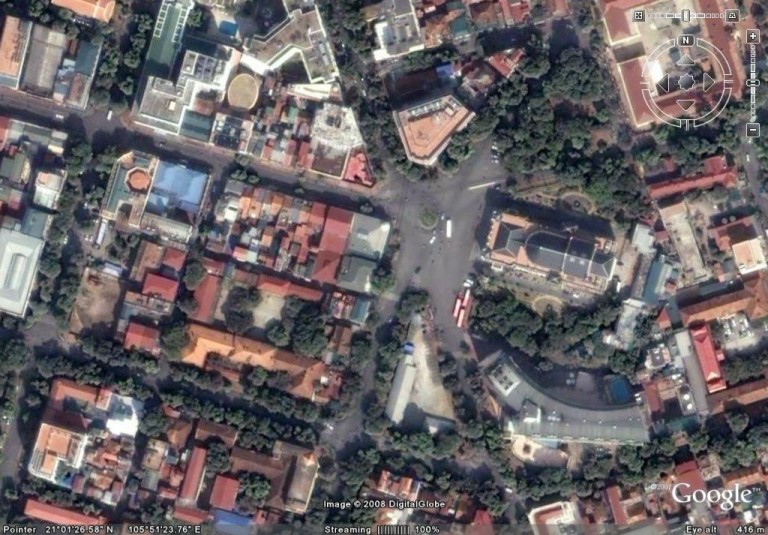
URBAN DESIGN IN SQUARES AND PUBLIC SPACES IN THE INNER suburbs OF HANOI
Public spaces such as squares, flower gardens, monument areas in the center of Hanoi inner suburbs have basically been shaped in terms of morphology. However, in order to improve the quality of space in terms of aesthetics, identity and culture commensurate with the position of the space of the central area of the Capital, it is still a problem that needs to be studied and solutions are needed through urban design.
Through the evaluation of square spaces, the current community space shows that the basic limitations are the lack of diversity in spatial forms and monotony in the function of the square. Both of these factors have significantly reduced the attractiveness of the community space.
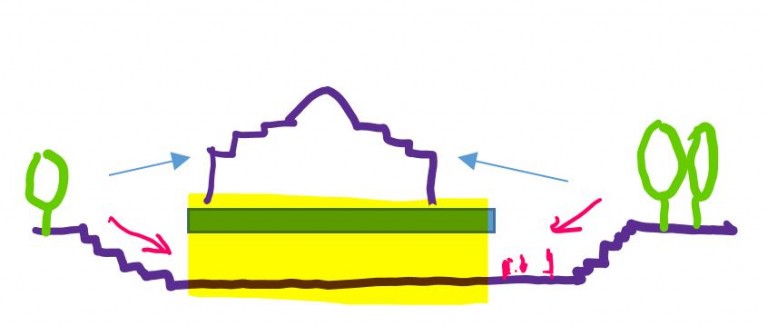
Design the underground space, create new functions, more diverse views
Important squares such as August Revolution Square, Dong Kinh Nghia Thuc Square or 1-5 Square (in front of Hanoi Friendship Cultural Palace), some monument spaces, flower gardens all face this limitation.
It is possible to create a way down to KG underground under the square by the entrance from the side of 2 parks
The monotony of the square function is manifested in the lack of participation of surrounding buildings that have other functions associated with the square. The reason is that the buildings around the community spaces still have the phenomenon of turning away from the square, exposed by the fence, there is no relationship between the function of the building and the space. For example, the Ministry of Transport, Hanoi Heart Hospital next to Square 1-5, Department of Culture and Communications, Hanoi Electricity Corporation next to the Monument of Death space next to Hoan Kiem Lake. This situation reduces the diversity of activities on the square, most obviously square 1-5.
This is a fairly common disadvantage of the design of squares in our country today, not only in Hanoi. Considering the square as an empty courtyard or if there is a design interest, there are only more monuments and gardens is a shortcoming of the intention to create a diversity of functions for this community spaces. Only when the square space is connected to the surrounding public buildings will it create a rich series of activities for the square, the daily vitality of the square, avoiding being just a space used for metting several times a year.
With the inner suburbs of Hanoi, due to the surrounding works, it is difficult to expand or adjust, or design new space or surrounding architecture. The spaces for walking cannot be expanded, unless completely changed to walking streets, walking squares. This is the limiting factor of historic municipalities.
Visual analysis shows that currently these spaces are only organized in a ground core. Squares, streets, stops or lakeside parks … are basically identified through the space of sight. If there are photos taken from above such as the shore of Hoan Kiem Lake, August Revolution Square … are from the high floors of neighboring structures, not from the community spaces themselves.
This feature is also a limitation in the community spaces organization because the tourist destination often has a rather limited vision, often separated by vehicles such as cars and motorcycles, so it has greatly reduced the efficiency of spatial and visual perception and impacted the effectiveness of perception.
Applying the theories of urban design to the problems of the community spaces, the inner suburbs square can now have the following solutions:
Solutions to create underground space and exploit the disparity in spatial organization
The creation of underground spaces is an important solution for the urban design of squares and community spaces, especially for the historic inner suburbs. The underground space adds a lot of missing functions on the square such as souvenir shops, fashion, works serving tourists, toilets, dining … Underground space also creates additional transport links without disrupting terrestrial transport links.
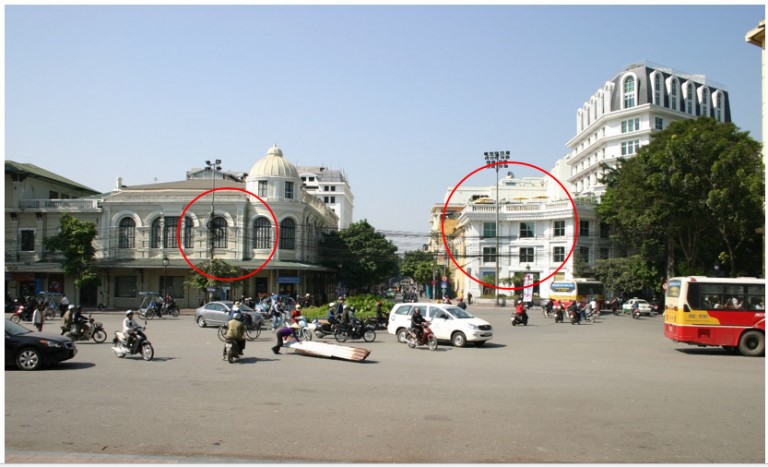
From the 2nd and 3rd floors of the surrounding buildings that need to be renovated to have a view of the Opera House Square
From the creation of underground space, many new community spaceswill be formed around the existing square with a variety of functions and forms. In which the new spatial morphology is mainly formed from the differential spaces. The community spaces may refer to:
- The community spaces is a direct access to the underground spaces beneath the square. For example, the road in front of the Opera House can be created 1 or 2 basements to serve as a center for services, tourism, and commerce. Access to that basement can go directly from the outside (from 2 adjacent parks) by creating steep spaces directly into the basements;
- The community spaces is located on the 2nd and 3rd floors of large construction complexes around the square. From this floor, it is possible to connect to the lower space (ground floor) or higher (floor 3,4) by the route outside the house;
- The space difference from natural factors, with Hanoi can be the difference of the surface of the Red River dikes compared to the inside of the dikes.
This disparity will create an opportunity for us to create new spaces with new, more vivid perspectives for the city. Concrete:
- It creates a broader, broader vision (*). For example, from the height of 6-8 m of the building around the Opera House overlooking the square, you will see a new beauty with a wide view, giving a new and more strange view. Psychologically, people also enjoyed sitting on the steep steps watching the active landscape below. With the Opera House space, having a seat to watch the theater is very necessary because the most beautiful theater view is currently on the roadway, very limited for viewing and taking photos with the building;
- The disparity point creates more attractive opening and closing spaces, due to the change that leads the space not only in horizontal opening and closing but also opening and closing up and down along the step and slope paths. Create new architectural accents and placements for commercial advertising;
- At the disparity point, it is possible to form more internal and external spaces, adding to community activities, exchanges and commercial promotion;
- It also creates new architectural forms: For example, it is possible to design steep slopes that differ in morphology, stone, and wood. Bridge corridors connecting high cores, overhead bridges … can create new architectural forms. In some central spaces, art statues, waterfalls, lighting arrangements can be arranged along the steps;
- It also requires the roadbed to be aesthetically designed, the methods of coloring, materials, and artistic lighting will come into play on these high-altitude change routes. Currently, the background design on the square has not been noticed, the walking paving materials are monotonous and there is a place to use quite inexpensive paving materials. While this is a surface that is often observed a lot, especially with walking space. Paving should use durable and beautiful materials such as stone, carved copper, load-bearing glass. Historical markers, historical stories can be recreated on these roadbeds.
Solution to create more community spaces from the ground floor of surrounding public buildings
The public buildings around the squares now mostly make the most of the ground floor area, for the building itself. Therefore, the spatial directions leading to the square are just streets. With the parallel of motorized traffic, it is difficult for these links to create new points to organize walking space.
However, in addition to low-rise commercial buildings, in the inner suburbs there are still many other public buildings with 4-5 floors, or up to 9 floors can be considered to use part of the ground floor, the ground floor is left empty, people can pass through.
When there is a new view through a street, facing the square will show us new perspectives, the street seems to be wider, the walking links are more flexible.
This solution has been applied in quite a few countries. Of course, in order for the owners of land plots to agree to leave part of the ground floor land area to the community spaces, the city government must have incentives, such as allowing high floors to be raised or about the cost of renting land…
Preserving the axis of the historical landscape, creating more views and links about the square space
The design of the spatial axis, the landscape towards the square, towards the central building on the square is a commonly applied method. French architects have designed very good planning, for example, Trang Tien street towards the Opera House, space route from the State Bank towards Hoan Kiem Lake …
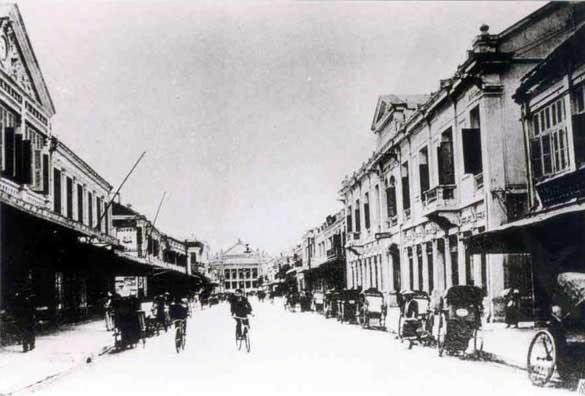
However, we have not yet noticed these intentions and have inadvertently or intentionally lost these spatial axes. For example, the construction of new structures is the Ly Thai To Monument that cuts off the space route from the Central Bank to Hoan Kiem Lake; or accidentally let trees grow with large canopies that have covered the view on Trang Tien street – Opera House … Currently, if you stand from the beginning of Trang Tien Street, you will not be able to see the Opera House at the end of the axis, due to being obscured by trees. In French photographs, without these green canopies, the landscape axes are clearly visible. Embassy Street is to guide the view of Hanoi Palace of Culture and Friendship, the main building on square 1-5, unfortunately it is a one-way street with the opposite view.
Therefore, it is necessary to review to preserve or create a view towards the square from about 200-250m away. From here there are navigational works. Do not have buildings that shield the view of the central building.
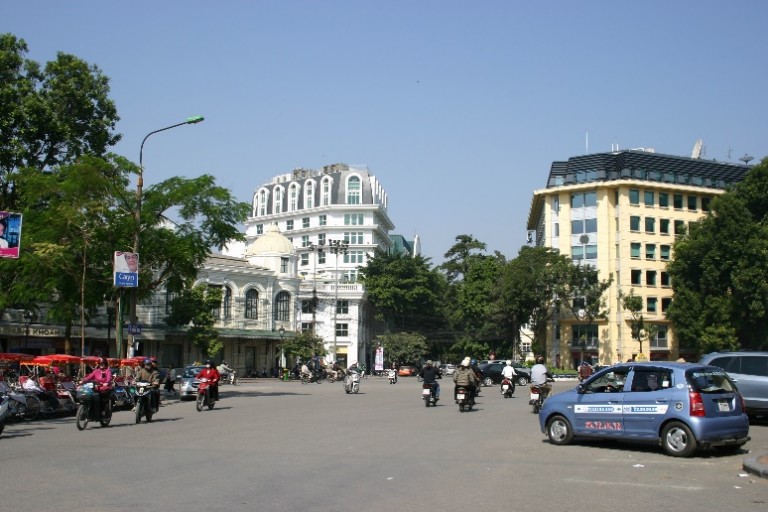
The view of the Opera House on Trang Tien street now is covered by trees.
Upgrade and renovate the architecture around the square
The architectural works around the square, community spaces greatly impact the aesthetic of space. Therefore, it is important to decorate and create beauty for the architecture. For each area, there will be different solutions. With the surrounding architectural area being a small-scale townhouse, the townhouse needs to create harmonious colors for an entire street, avoiding the minutiae of strong colors. For public works, large array architectural forms need to minimize visual impacts such as: Avoid using reflective glass, bright colors or too dark colors; It is necessary to pay attention to the specificity of the regional architecture, preferably preserving or creating features in a certain style, clearly bearing the historical imprint of the space.
With some of the above solutions, it is still possible to use urban design solutions to create new functional and aesthetic values for squares in the historic inner suburbs of Hanoi. Solutions to create basements, cores, create more extra space, guide space, renovate architecture … can be done with the least demolition or displacement intervention but still highly effective.
Currently, there is a lack of policies to attract investment in urban square design. Therefore, it is necessary to pay attention to the investment of districts and cities to gradually implement urban design projects.