
Hanoi’s Young Design Generation Takes the Stage at “Creativity Flow” 2026
Opening on the afternoon of 27 June at the 22 Hang Buom Cultural and Arts Center, the “Creativity Flow” 2026 exhibition by the Faculty of Arts and Design, School of Interdisciplinary Sciences and Arts, Vietnam National University, Hanoi, presents student practices in design, art and photography within a heritage space in the Old Quarter. Moving from the classroom into urban life, the exhibition suggests the role of creative education in nurturing a young talent pool for the capital’s cultural industry ecosystem.
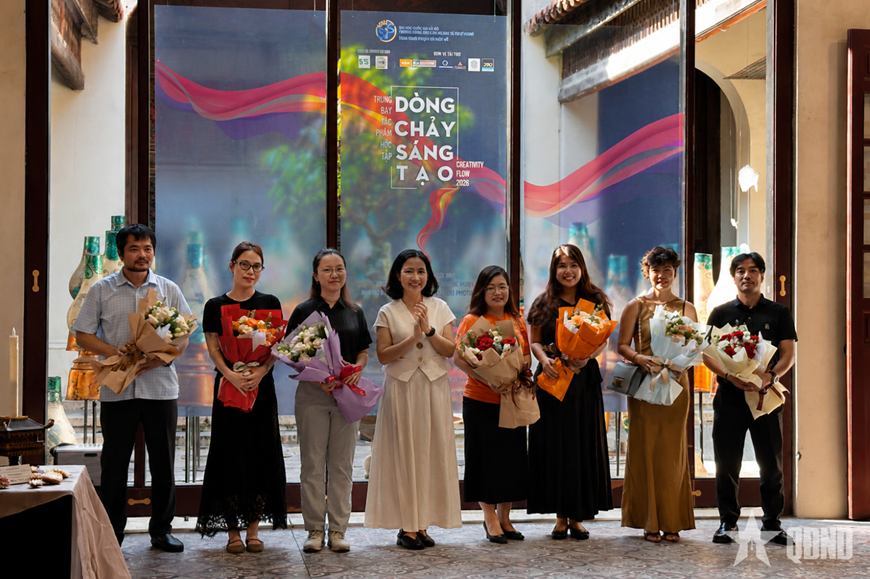
The organizers present flowers to the distinguished guests in appreciation during the opening ceremony of the “Creativity Flow” Exhibition. Photo: People’s Army Newspaper.
On the afternoon of 27 June, at the 22 Hang Buom Cultural and Arts Center, the “Creativity Flow” 2026 exhibition officially opened, introducing selected works from the learning and practice process of students from the Faculty of Arts and Design, School of Interdisciplinary Sciences and Arts, Vietnam National University, Hanoi.
More than a year-end academic showcase, the exhibition places young design practices within the space of the Old Quarter — where urban memory, architectural heritage and contemporary creative life coexist. In this setting, “Creativity Flow” 2026 becomes a meeting point between arts education, professional practice and the urban public.
As Hanoi continues to expand its network of cultural and creative spaces, the question of the next generation of creative talent has become increasingly important. From studios, galleries, art spaces, community venues, craft villages, museums and heritage sites to cultural institutions, the capital’s creative ecosystem cannot be built solely on venues and events. More fundamentally, it requires young people who are systematically trained, capable of design thinking and interdisciplinary work, able to understand local cultural materials, and equipped to transform ideas into concrete creative products, experiences and services.
In that sense, “Creativity Flow” 2026 can be seen as a slice of the classroom brought into public view: a place where students do not simply complete academic assignments, but learn to take their works beyond the boundaries of the classroom and into dialogue with space, community and the professional market.
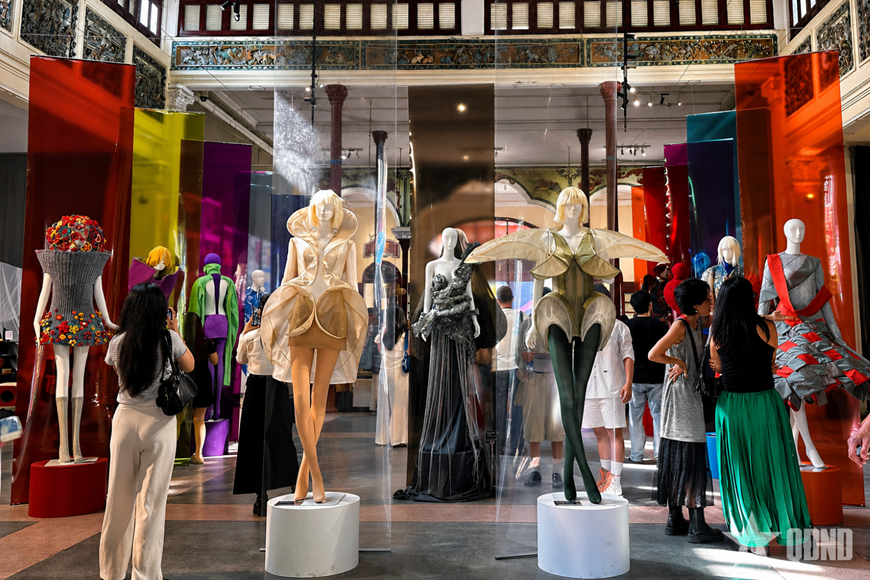
The exhibition space showcases a wide range of creative designs, offering visitors an impressive visual experience. Photo: People’s Army Newspaper.
Following the 2025 edition, this year’s exhibition presents outstanding works across several training directions: digital graphic design, sustainable interiors, fashion and creativity, contemporary visual arts, and fine art photography. This diversity reflects the broad scope of design and arts education today, as creativity no longer remains enclosed within separate disciplines but increasingly moves across technology, materials, images, space, the body, the environment and social life.
One of the exhibition’s notable aspects is its choice of venue. The 22 Hang Buom Cultural and Arts Center, located in Hanoi’s Old Quarter, is not a “neutral” gallery space. It carries multiple layers of urban memory, where each work, once placed within the site, enters into an additional dialogue with the history, architecture and rhythms of life in the heart of the capital. This encounter helps the exhibition move beyond the framework of an ordinary student showcase, becoming a cultural and artistic activity connected to urban life.
Speaking at the opening ceremony, Dr. Nguyen Kieu Oanh, Vice Rector of the School of Interdisciplinary Sciences and Arts, emphasised an educational spirit closely linked to practice, creative studios and real professional environments. According to her, the school creates conditions for students to develop creative thinking and turn ideas into concrete products. At the same time, through the support of lecturers, businesses and partners, assignments within the training programme have the opportunity to expand into real exhibition spaces.
This message is particularly meaningful in the context of creative education today. In the fields of design, art and visual communication, learners’ abilities are measured not only by technical proficiency or the completion of coursework, but also by their capacity to present ideas, critique products, receive feedback, work with real contexts and understand the public. An exhibition open to the community is therefore part of the educational process: students step into an environment closer to professional practice, while the public has the chance to witness new movements in young creative thinking.
Alongside the exhibition space at 22 Hang Buom, the “Creativity Flow” 2026 programme also extends to the Hanoi Old Quarter Cultural Exchange Center at 50 Dao Duy Tu, Hoan Kiem. Within the programme, two professional talks are organised: “Derivative and Appropriation Art — Copyright in the Age of AI” at 9:00 a.m. on Thursday, 2 July, and “The Flow of Fine Art Photography in Vietnam” at 9:00 a.m. on Saturday, 4 July.
The placement of these topics alongside the exhibition shows that the programme does not look only at learning outcomes, but also brings young people into the issues now strongly shaping creative life. These include intellectual property in the age of artificial intelligence, the boundaries between derivation, reference, appropriation and new creation, as well as questions about the position, language and development of Vietnamese fine art photography in an international context.
From the perspective of Hanoi as a Creative City, activities such as “Creativity Flow” 2026 carry significance on several levels. At the educational level, they represent an effort to connect training with practice and bring students closer to professional environments. At the level of urban culture, they activate heritage spaces through contemporary creative activities. At the level of cultural industries, they contribute to preparing human resources — an indispensable factor if Hanoi is to develop its creative sectors sustainably.
Hanoi is working towards making cultural industries a new driver of growth. But for that goal to take root in everyday life, the city needs not only policies, events and spatial infrastructure, but also a generation of creative practitioners with professional competence, an understanding of heritage, technological fluency and the ability to connect with communities. From studio assignments to works exhibited in an Old Quarter heritage space, “Creativity Flow” 2026 shows that this process is taking shape through concrete steps.
The exhibition is open until 5 July 2026 at the 22 Hang Buom Cultural and Arts Center and the Hanoi Old Quarter Cultural Exchange Center, 50 Dao Duy Tu, Hoan Kiem. Opening hours at 22 Hang Buom are from 8:00 a.m. to 5:00 p.m., Monday to Thursday, and from 8:00 a.m. to 9:00 p.m., Friday to Sunday. Admission is free.
Source: https://hanoicreativecity.com/the-he-thiet-ke-tre-ha-noi-trinh-dien-tai-dong-chay-sang-tao-2026/