
Architecture “Learning” to Listen to a Wounded World
In an era where climate change, ecological crises, and social fractures are forcing architecture to reexamine its very foundations, the question “How can we live with this world?” has become a central thread running through many contemporary practices. On July 30, 2025, at the French Institute in Hanoi, the talk show “Living With – From Forest House to La Biennale Venice” opened a rare space for exchange, connecting architectural practices, research, planning, and curation between Vietnam and France. The event was organized by the French Institute in Hanoi and Hanoi Ad hoc / Ad hoc Practice, with support from Gỗ Minh Long and Ashui.
From Venice to Hanoi: A Biennale Focused on “Working with What Exists”
At La Biennale di Venezia 2025, the curatorial team Jakob + MacFarlane chose an approach of reviving existing structures – rather than building entirely new displays. They transformed the building itself into the primary material, opening six interconnected themes that form the French Pavilion: “Living with What Exists,” “Living with the Adjacent,” “Living with Vulnerability,” “Living with Fragility,” “Living with Nature,” and “Living with Collective Intelligence.”
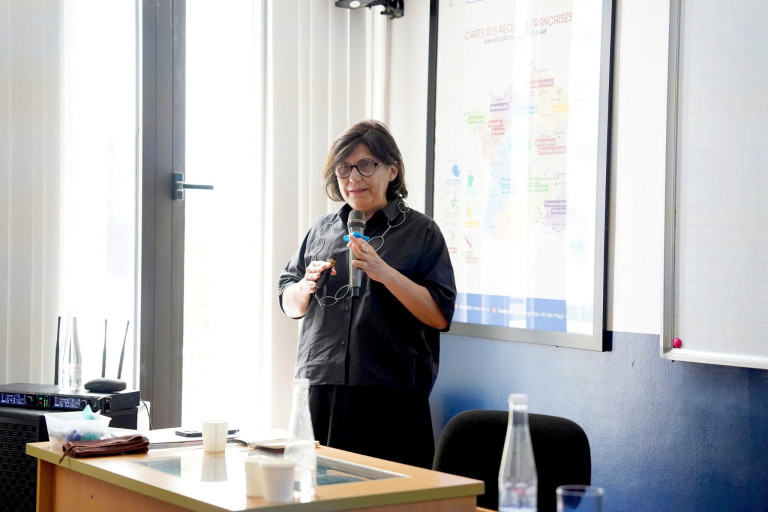
Architect Dominique Jakob exchanging at the talk show “Living With – From Forest House to La Biennale Venice” (Photo: Architecture Magazine)
Co-founder of Jakob + MacFarlane and curator of the French Pavilion, architect Dominique Jakob shared that: Today’s architecture is about listening – listening to old materials, ecosystems, communities, and ongoing vulnerabilities. With this philosophy, her studio has long been committed to digital experimentation, non-traditional materials, and social engagement in projects such as Orange Cube (Lyon), The Docks – Cité de la Mode et du Design (Paris), or the Euronews headquarters. This has also shaped their distinctive voice and imprint at this year’s La Biennale di Venezia.
Trung Mai and the Journey from “Forest House” to Biennale
Dialoguing with Jakob at the talk was architect, urban planner, and curator Trung Mai (Mai Hưng Trung). He founded the office Hanoi ad hoc / Ad hoc Practice in 2020. Holding dual French-Vietnamese citizenship, practicing at the intersection of creativity, urban research, and architectural curation, he is one of the Vietnamese figures consistently recognized on the international stage.
He is the first Vietnamese to win the European prize three times (sessions 15, 16, 17) in Spain, Italy, and France; nominated for the Prince Claus Seed Award (Netherlands), Architizer A+ Award (USA), IBA’27 (Germany), and participated in major international competitions from Siberia to Bangkok. His works have been featured at the 19th Venice Architecture Biennale “Intelligens” curated by Carlo Ratti, and at this year’s French Pavilion “Living With.” He has taught at RMIT Melbourne, École Spéciale d’Architecture (Paris), ENSA Paris-Belleville, and is currently a visiting lecturer at ENSA Versailles.
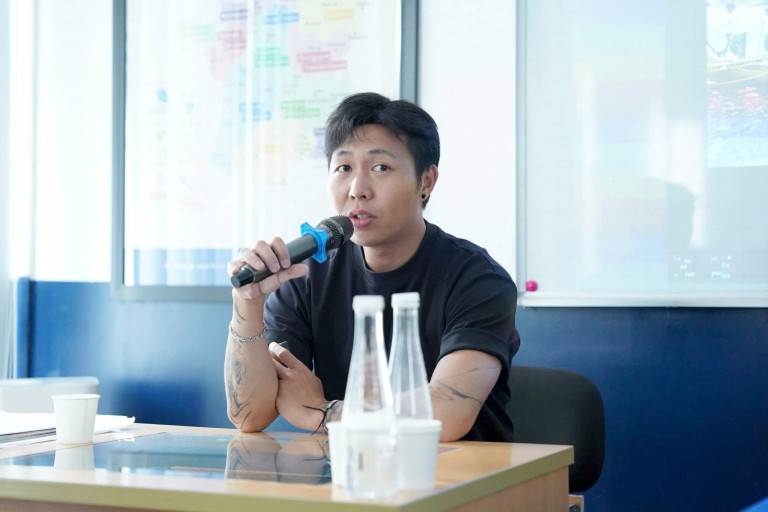
Architect Trung Mai shares about Maison Forêt (House of the Forest) (Photo: Architecture Magazine)
A highlight of Trung’s practice is his sensitivity to the “ad hoc” improvisational, flexible, and adaptive nature characteristic of Vietnamese cities. He views this not only as an intangible identity but as a decolonizing method, an architectural strategy enabling cities to adapt to the Anthropocene era.
In the talk, the Maison Forêt (House of the Forest) project was introduced as a typical cross-section of the “Living With” philosophy: Rather than imposing architecture on the forest, the structure is envisioned as one that learns from the forest by absorbing indigenous knowledge, landscape, and ecosystem rhythms – Maison Forêt is thus not just a residential model but a proposal for living with, rather than dominating, the environment.
Hanoi in the Global Architectural Flow
The talk revealed that many issues in Vietnamese architecture – from climate change, urban density, landscape loss, to restructuring living spaces – are present in international discussions. The Hanoi discussion brought three important signals:
- First, architectural practices in Vietnam are gradually entering dialogue with the global creative ecosystem, no longer isolated or “on the sidelines.”
- Second, indigenous knowledge, especially ecological knowledge, has the opportunity to become part of architecture’s future if interpreted in contemporary language.
- Third, Vietnam’s young architectural community is increasingly accessing academic spaces – exchanges – collaborations.
As a supporting partner, Gỗ Minh Long serves as an important bridge between Vietnam’s interior design and architecture community and international thought flows. Beyond sponsorship, they contribute to creating meeting environments where local practices have the chance to be heard, seen, and developed.