
The Easier to Create, the Harder to Protect: The Copyright Dilemma in the Digital Age
The digital era has unlocked unprecedented opportunities for Vietnamese creators: anyone can produce content, and anyone can reach millions of viewers in mere seconds. However, this limitless expansion has birthed a paradox: as content flourishes, copyright infringement explodes, spreading with uncontrollable speed. In an environment where a video can be cloned in an instant and a book scanned just hours after release, copyright is becoming the primary “bottleneck” hindering the ability to monetize creativity—a sector expected to become Vietnam’s new growth engine.
The Proliferation of Digital Content Erodes Copyright Boundaries
The proliferation of social media and sharing platforms has driven digital content growth at a pace that defies all traditional frameworks. Videos, music, podcasts, e-books, and designs are created, distributed, and disseminated in mere seconds. The distance between creator and consumer has vanished; anyone can be a content producer and, in the same stroke, inadvertently become a copyright infringer.
This context has created a ‘flat’ environment where original content can be downloaded, edited, and reposted in an instant. A work born of immense effort, investment, and original thought can be distorted into countless new versions, spreading so widely that audiences struggle to distinguish the original from the copy. According to recent statistics, 80% of copyright infringements now occur on digital platforms, accurately reflecting the fragility of these boundaries.
More concerning is the sheer scale of users engaging with pirated content. In 2024 alone, it is estimated that 15.5 million people in Vietnam regularly accessed pirated websites, placing the nation among the top three countries with the highest piracy access rates in the region. This figure is substantial enough to create a robust, pervasive ‘parallel market’ that is nearly impossible to regulate through traditional measures alone.
Platform algorithms further accelerate the ‘erosion’ of copyright boundaries. Systems prioritize high-engagement content regardless of its origin, inadvertently pushing re-uploaded videos to trend faster than the originals. A meticulously produced product can easily be overshadowed by cloned versions that are better tailored to ‘algorithmic tastes.’
The result is an increasingly stark paradox: The easier it is to create, the harder it is to protect. In this relentless flow of content, while technology empowers everyone to produce, copyright—the very pillar that transforms creativity into an economic sector—is being eroded daily on the very platforms that fueled its growth.
A Fragile Ecosystem: Widespread Infringement Across Creative Industries
Cinema: An Unequal Battle Between Theaters and Illegal Livestreams
The Vietnamese film industry is struggling against a grim reality: from global-scale pirate websites to surreptitious recording and illegal livestreaming of theatrical content. Together, these factors have created a ‘lawless frontier’ for copyright infringement, where the damage extends far beyond revenue to undermine trust, rights, and the very future of cinema.
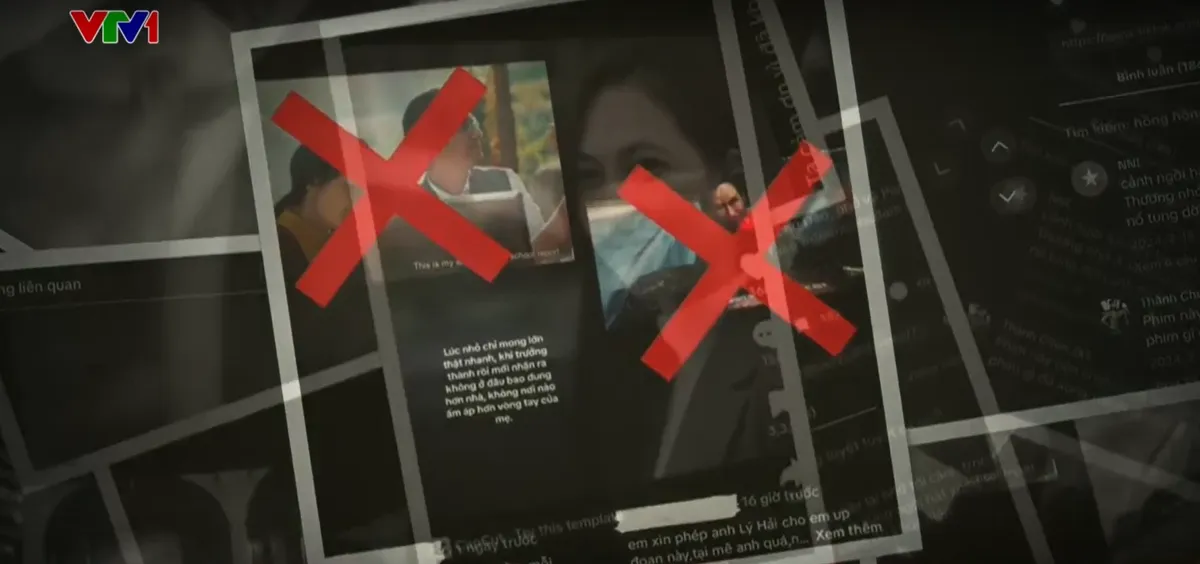
According to the Vietnam Cinema Department, over 400 Vietnamese-language websites currently distribute tens of thousands of films illegally, operating as complete business models with advertisements, VIP packages, and virtual top-up cards. These are not spontaneous platforms but a well-organized ‘piracy ecosystem’ that continuously expands by shifting domains whenever penalized—a ‘cat-and-mouse’ game that has persisted for years. A 2021 survey by the Asia Video Industry Association’s (AVIA) Coalition Against Piracy, conducted by YouGov, revealed that 60% of Vietnamese consumers admit to streaming pirated content. These figures reflect a deeply ingrained piracy habit, large enough to create a parallel market that competes directly with legal distribution systems.

Photo: VTV
The speed and sophistication of cloning are also intensifying. The case of the film ‘Dad, I’m Sorry’ (Bố Già), which saw over 10 pirate links emerge less than 24 hours after its release on Galaxy Play, serves as a stark example: as soon as content is launched, pirated versions immediately flood familiar domains such as phimgiz, fullphimmoi, or bilutvs. Most notably, the crackdown on Fmovies—one of the largest pirate sites operating from Vietnam—revealed nearly 50,000 infringing titles and a staggering 6.7 billion visits in the first half of 2024. The case demonstrates that film piracy is not merely an individual act but a large-scale illicit profit model, generating hundreds of thousands of dollars in advertising revenue.
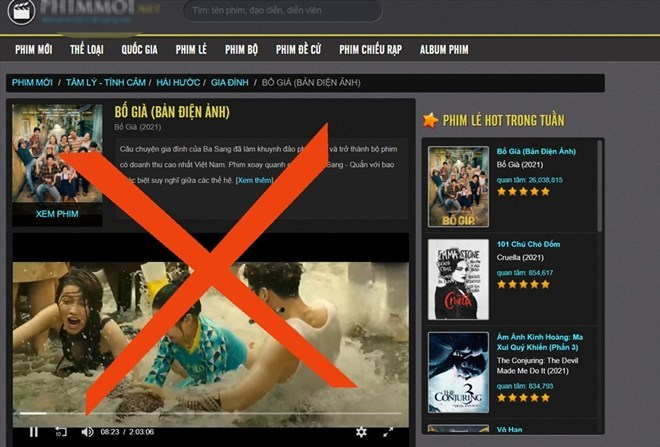
The movie “Dad, I’m sorry” was once illegally screened. Photo: Lao Dong Newspaper.
While producers invest capital, human resources, and time to bring films to audiences legally, the piracy ecosystem profits from those very products without incurring any copyright costs. The consequence is not just a loss of revenue but a decline in investor confidence, making it difficult for Vietnamese cinema to develop sustainably when the business environment is distorted by an ever-expanding black market.
Music: When Re-uploading Becomes the ‘New Normal’
In the performing arts sector, copyright infringement is evolving with increasing complexity, diversity, and sophistication. According to the Vietnam Center for Protection of Music Copyright (VCPMC), many event organizers—both domestic and international—still lack the proactive commitment to settle royalty payments. It is not uncommon for programs to utilize dozens or even hundreds of songs without prior authorization or with only partial licensing, creating significant hurdles in protecting the rights of songwriters and music producers.
Within commercial businesses utilizing music, the abuse of ‘fee negotiation’ mechanisms to evade obligations remains widespread. Many entities cite an ‘inability to reach an agreement’ as a pretext to delay signing licensing contracts, or even shift the responsibility onto recording providers, despite the law clearly stating that the user is the primary subject required to obtain permission and pay fees. This creates a major void in the copyright protection system, particularly in sectors such as hospitality, retail, and small-scale events, where music is used extensively while copyright obligations are largely ignored.
In the digital sphere, music copyright violations are equally damaging. The re-uploading of content on YouTube has become pervasive: ‘lyrics videos,’ ‘speed-up,’ ‘slow-down,’ or ‘no ads’ versions are reposted indiscriminately, with many garnering millions of listens—sometimes even surpassing the official releases. To bypass automated copyright identification systems, uploaders often manipulate the audio by altering the tempo, distorting the sound, or sampling segments of the track. These modifications are subtle enough to evade filters while retaining a musical impression close to the original, leading to massive losses in advertising revenue and directly undermining artists’ interests.
On rapid-sharing platforms like TikTok, the issue is even harder to regulate. Music is treated as a generic background element, freely attached to both personal and commercial videos. Copyright experts warn that the mass usage of music without valid licensing channels has created a vast amount of ‘gray zone’ content, where users inadvertently infringe upon copyrights. Platform mechanisms, despite having verification tools, still struggle to keep pace with the speed of content dissemination, especially when algorithms prioritize trending sounds regardless of their origin.
The confluence of low user awareness, legal loopholes, and the hyper-accelerated circulation of digital platforms has made music one of the hardest-hit sectors. Artists, producers, and distributors alike suffer from revenue leakage, reduced reinvestment capacity, and the struggle to defend their rights in a digital environment that is overly ‘open’ yet lacks effective protective barriers.
Legal Loopholes in Digital Copyright Protection
While digital copyright infringement continues to escalate, criminal prosecutions remain exceedingly rare. This disparity highlights that existing regulations are failing to keep pace with increasingly sophisticated and rapidly spreading violations. In many instances, even with clear evidence, bringing a case to trial proves difficult, resulting in a prolonged and ineffective protection process for creators’ rights.
The consequences extend beyond revenue leakage. When creative works are easily cloned, leaving legitimate producers at a disadvantage, the incentive for investment and innovation inevitably withers. Legitimate businesses face unfair competition, the state suffers from lost tax revenue, and the entire cultural industry is eroded at its very foundation.
Despite numerous revisions to Vietnam’s Law on Intellectual Property and the issuance of relevant decrees, significant gaps persist. Experts argue for a comprehensive synchronization of the legal system—spanning the Law on Intellectual Property, the Law on E-commerce, and the Civil Procedure Code—to clearly define the responsibilities of platforms, intermediaries, and end-users. Without such legal interconnectivity, efforts to combat digital copyright infringement will struggle to achieve tangible impact.
If these legal voids are not promptly addressed and the culture of copyright respect is not elevated, the digital environment will remain fertile ground for infringement. When creators are left unprotected, the creative market cannot flourish; and without a thriving market, the ambition to build a sustainable cultural industry will remain out of reach. Protecting copyright is, therefore, not merely about safeguarding authors—it is about securing the very future of Vietnam’s creative economy.
Source:
- https://laodong.vn/van-hoa-giai-tri/noi-nhuc-nhoi-xam-pham-ban-quyen-phim-tren-khong-gian-mang-1270706.ldo
- https://daidoanket.vn/phim-viet-lao-dao-vi-bi-vi-pham-ban-quyen.html?utm_source=chatgpt.com
- https://www.vietnam-briefing.com/news/intellectual-property-vietnam-lawsuit-wolfoo-peppa-pig.html/?utm_source=chatgpt.com
- https://www.youtube.com/watch?v=eKwhet5LBGU
- https://laodong.vn/van-hoa-giai-tri/phim-viet-bi-sao-chep-chieu-lau-tran-lan-va-nhung-tieng-keu-cuu-924006.ldo
- https://tuoitre.vn/cong-an-ha-noi-triet-pha-website-fmovies-voi-gan-50-000-phim-lau-20241109125900434.htm?
- https://abei.gov.vn/thong-tin-dien-tu/mot-loat-cac-trang-web-cung-cap-phim-bi-to-vi-pham-ban-quyen/106816
- https://www.vcpmc.org/giai-phap-cho-van-de-ban-quyen-am-nhac-n2803.html
- https://vtv.vn/diem-nghen-phap-ly-khien-viec-giai-quyet-vi-pham-ban-quyen-gap-kho-100251031120154361.htm