
Four of Five National First Prizes: A Look at the Creative Vitality of Hanoi’s Crafts
Ceramics designed for Vietnamese tea spaces, an artwork on silk, a rattan lamp and a lotus motif crafted from precious metal. Four works, each employing different materials and techniques, have earned Hanoi four of the five First Prizes at the 2026 Vietnam Handicraft Products Competition. Beyond recognising the achievements of individual artisans, the results offer an insight into how Hanoi’s traditional crafts are finding new forms of expression in contemporary life.
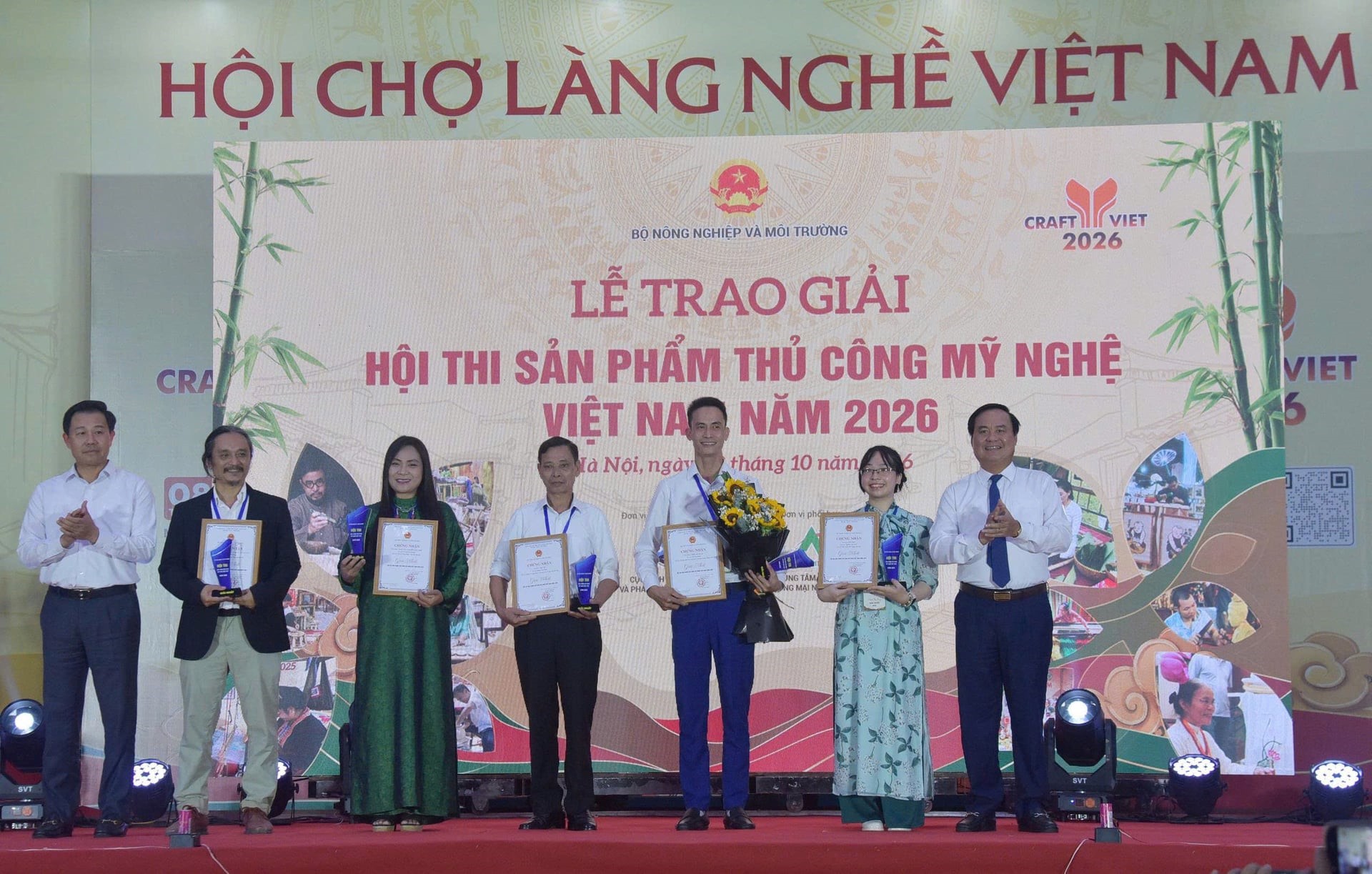
On the evening of October 8, the Ministry of Agriculture and Environment held the awards ceremony for the 2026 Vietnam Handicraft Products Competition in Hanoi. This year’s competition attracted 453 entries from 256 individual creators and groups across the country, with 55 works selected for awards.
The organizers present first prizes to outstanding entries at the 2026 Vietnam Handicraft Products Competition. Photo: Organizing Committee.
Of the five First Prizes, four went to creators from Hanoi.
The winning works were Decorative Ceramics for Vietnamese Tea Spaces by Ngô Bá Hoàng, Touching the Essence of Heaven and Earth by Lê Thị Lan Hương, Rattan Lamp by Nguyễn Văn Vinh, and Lotus in Bloom by Phạm Thu Thủy. The remaining First Prize went to Vũ Văn Hoan from Hưng Yên Province for his work The Torn Basket.
Winning four out of five First Prizes is a remarkable result. Yet what makes it particularly interesting is the nature of the four winning works themselves.
They represent neither a single craft nor a single artistic style. Ceramics, silk, rattan and bamboo, and metalwork all feature among the highest award-winning entries. Together, they reveal a defining characteristic of Hanoi’s craft ecosystem: the city’s creative capacity extends across a wide range of materials, techniques and craft traditions.
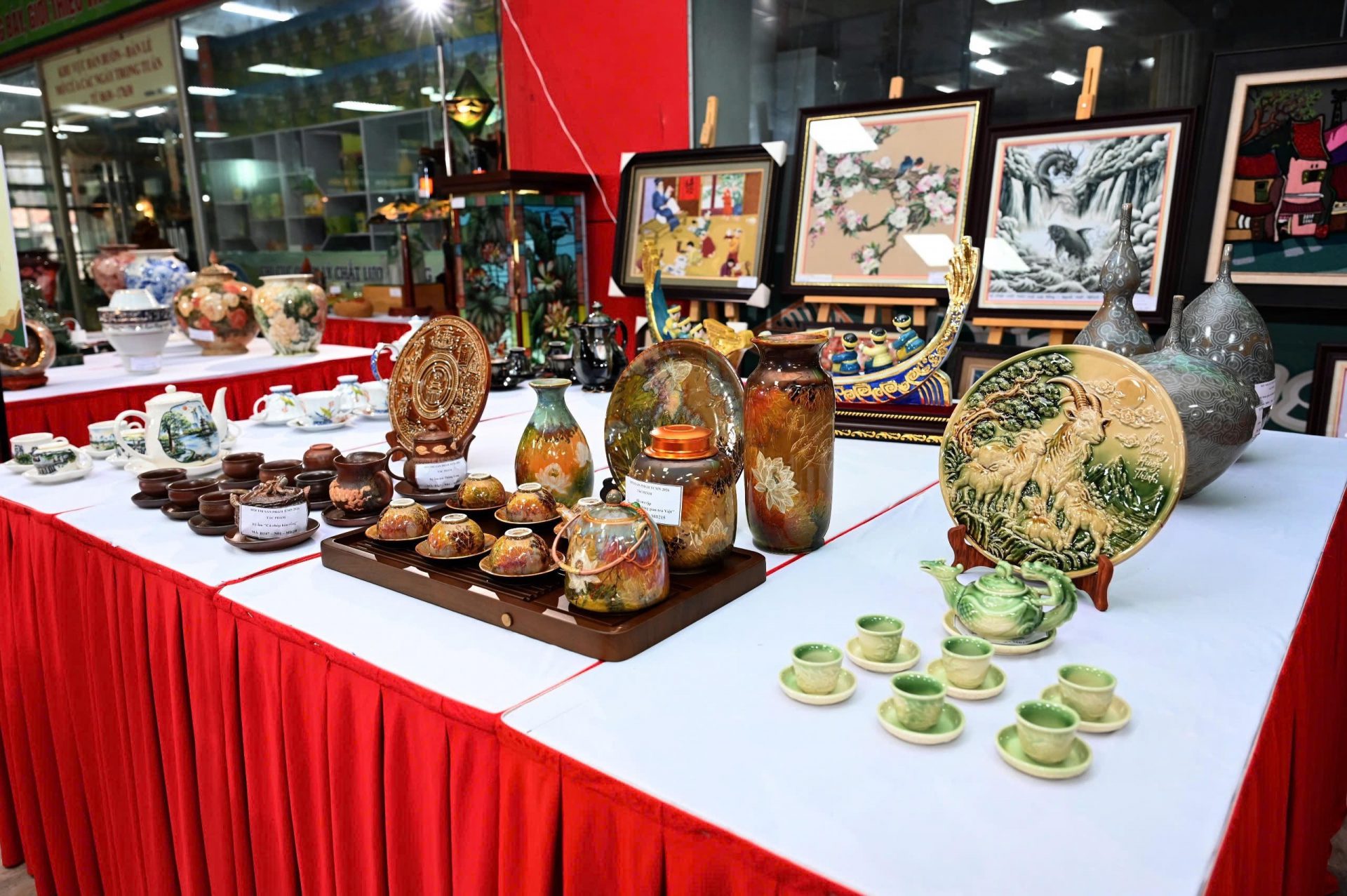
The “Decorative Ceramics for Vietnamese Tea Spaces” collection by Ngo Ba Hoang
Four Materials, Four Ways of Engaging with the Present
The title Decorative Ceramics for Vietnamese Tea Spaces suggests an ambition beyond simply creating a ceramic object. It places ceramics within a specific setting — the Vietnamese tea-drinking space — where material, function and culture come together.
Rattan Lamp, meanwhile, introduces a familiar traditional material into the context of contemporary living spaces. Rattan and bamboo have long been associated with traditional household objects. When incorporated into lighting design, however, weaving techniques take on new functions: shaping the object, controlling the light and creating the atmosphere of a space.
The other two works, Touching the Essence of Heaven and Earth and Lotus in Bloom, further demonstrate how familiar symbols, materials and techniques can be explored through new forms of artistic expression.
What matters here is not whether these products are more “modern” or more “traditional”.
Rather, it is that their creators have not treated craftsmanship as an end in itself. Instead, traditional techniques have become a means of addressing design challenges.
This represents an important shift in how traditional crafts are understood.
In the past, a handcrafted product was often judged primarily by its intricacy, technical mastery and the skill and effort invested in its creation. These qualities remain essential, but this year’s competition introduced additional requirements: entries must demonstrate original ideas, avoid imitation, serve a clear purpose, suit contemporary life and offer potential for further development.
In this context, “mastery of a craft” and “creative capability” are no longer regarded as interchangeable concepts.
From Preserving Traditional Crafts to Developing New Forms of Expression
Hanoi is home to an exceptionally diverse network of traditional craft villages. Yet the number of craft villages alone cannot guarantee that these traditions will continue to thrive across future generations.
The more important question is whether traditional techniques can continue to give rise to new products.
From this perspective, Hanoi’s four First Prizes can be viewed as small but revealing examples of a much broader transformation.
Ceramics need not simply reproduce familiar vases, jars or ritual objects. Rattan and bamboo need not be confined to baskets, trays or traditional household utensils. Silk, embroidery and metalwork are likewise not limited to forms established decades ago.
When craftspeople can draw upon traditional knowledge as a “language” for creating new products, their crafts begin to acquire the capacity for renewal from within.
This also offers another way of understanding conservation.
Preserving traditional crafts does not necessarily mean reproducing the exact products of the past. What needs to be preserved at a deeper level is the craftsmanship itself: techniques, knowledge of materials, experience in shaping forms, collective craft memory and the creative capacity of the community.
As long as these elements can continue to generate something new, heritage remains alive.
Seventy Years Between the Youngest and Oldest Participants
This year’s competition also revealed a noteworthy detail: the oldest participant was 81, while the youngest was just 11 years old and came from Hanoi.
That 70-year age gap illustrates how traditional crafts can continue to connect generations.
Yet for such connections to endure, younger generations must see traditional crafts not merely as a responsibility to preserve the past, but also as a field in which they can create.
This is an issue that Hanoi Creative City has repeatedly explored through its programmes on contemporary craftsmanship: young people need opportunities to engage directly with craft villages, artisans, production processes and the distinctive “design DNA” of each craft, before experimenting with new interpretations.
Seen from this perspective, a national competition matters for more than the number of prizes it awards.
It provides a platform where experiments by different generations and from different craft-producing regions can be brought together, offering a glimpse of the directions in which Vietnamese craftsmanship is evolving.
What Do Four of Five First Prizes Say About Hanoi as a Creative City?
The results of a single competition should not be taken as proof that Hanoi has already developed a fully established craft design ecosystem.
Nevertheless, winning four of the five First Prizes is a significant indication of its creative potential.
Hanoi is recognised by UNESCO as a member of the Creative Cities Network in the field of Design. If design is understood as extending beyond architecture, graphic design and modern industry, traditional craftsmanship represents one of the city’s oldest repositories of design knowledge.
Every handcrafted object embodies a series of design decisions: which materials to use, what proportions to adopt, which forms best serve their intended functions, how surfaces should be finished, and which techniques can give a material its desired shape.
What is new today is the need for these decisions to remain in dialogue with contemporary life.
Hanoi’s four First Prizes demonstrate that this dialogue is taking place across a variety of materials.
And it is precisely this diversity that deserves attention.
A Creative City needs more than a collection of outstanding “creative products”. It needs the capacity to continually develop new approaches, drawing upon existing bodies of knowledge.
For Hanoi, its traditional craft villages and craftsmanship could provide one of those foundations.
Awards Are Not the End of the Journey
The 55 award-winning works were subsequently presented at the 22nd Vietnam Craft Villages Fair, held from October 8 to 12 at the Agricultural Exhibition Centre, 489 Hoàng Quốc Việt Street, Hanoi.
For Hanoi’s four First Prize-winning works, however, the more important question concerns what comes next.
Will these ideas be developed further? Will these new visual languages influence the traditional craft villages from which they emerged? Will younger generations look at these achievements and see a different future for traditional craftsmanship?
These are the questions that will ultimately measure creative vitality over the long term.
Hanoi’s four First Prizes can therefore be seen as four small glimpses into a larger story: the city’s traditional crafts are not merely being preserved.
They are continuing to be redesigned from within.
Sources
- Hànộimới Newspaper, “Hanoi Wins Four of Five First Prizes at the 2026 Vietnam Handicraft Products Competition”, October 8, 2026.
- Agency for Cooperative Economy and Rural Development, Ministry of Agriculture and Environment, “Nearly 500 Unique Products Gather at the 2026 Vietnam Handicraft Products Competition”.
- Agency for Cooperative Economy and Rural Development / Agriculture and Environment Newspaper, information on the 22nd Vietnam Craft Villages Fair and the 2026 Vietnam Handicraft Products Competition.
- https://hanoicreativecity.com/4-5-giai-nhat-quoc-gia-nhin-vao-suc-sang-tao-cua-thu-cong-ha-noi/