
International Artists Begin Creative Residency Programme in Hanoi
International groups of artists have arrived in Hanoi to prepare for the first-ever artist residency programme organised as part of the Hanoi Creative Design Festival 2026. Rather than simply bringing completed works for performance or exhibition, the artists will work directly with Vietnam’s creative communities, explore local spaces and collaborate on the development of new projects.
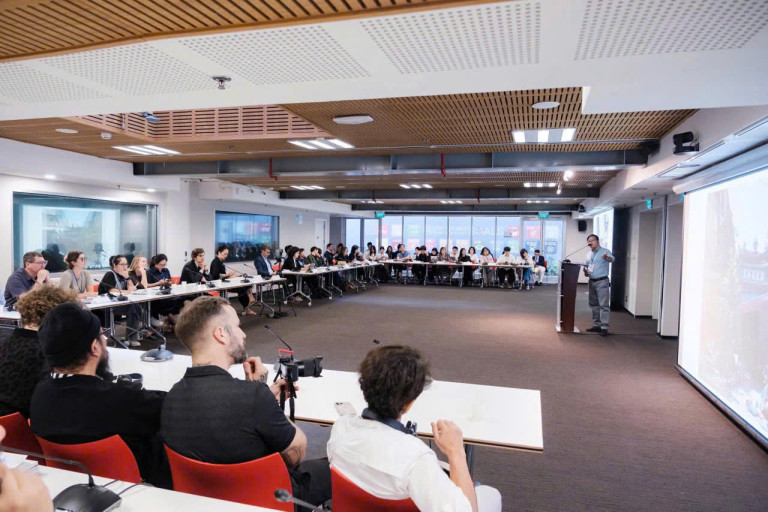
On the afternoon of 2 November, the organisers of the Hanoi Creative Design Festival 2026 hosted a meeting with international artist delegations participating in the residency programme at the Green One UN House in Hanoi.
The event brought together representatives of the Hanoi municipal government, the Hanoi Department of Culture, Sports and Tourism, the Vietnam Association of Architects, Architecture Magazine, as well as embassies, cultural foundations, development organisations and members of the domestic and international design and creative communities.
The gathering marked the transition from planning to implementation for one of the Festival’s most notable new initiatives.
The organisers of the Hanoi Creative Design Festival 2026 meet with international artist delegations participating in the residency programme. Photo: Architecture Magazine.
From International Guests to Creative Collaborators
For the first time, an artist residency programme has been incorporated into the Hanoi Creative Design Festival.
Unlike conventional arrangements in which international artists are invited to participate in programmes that have already been developed, an artist residency allows participants to spend time exploring, researching and working directly within the host city.
According to the organisers, the programme brings together three principal areas of activity: collaborative research, co-creation and technical knowledge transfer.
International artists are expected to work alongside Vietnamese creative communities at distinctive locations across Hanoi, including Hang Dau Water Tower, Dong Xuan Market and several theatres.
This approach means that the creative process will be closely connected to the places in which it takes shape.
Architecture, history, urban life, the communities that inhabit and use these spaces, and existing local creative practices may all contribute to the development of new works.
This represents a significant departure from conventional cultural exchange programmes. The value lies not only in giving Hanoi audiences access to international artistic work, but also in enabling Vietnamese and international artists to collaborate and exchange creative approaches and working methods.
Putting Collaboration Before the Final Outcome
According to the organisers, the Festival’s curatorial team has worked throughout the preparation process to mobilise funding, secure investment in artistic production and establish partnerships with professional organisations across borders.
The objective is not merely to produce works for presentation during the Festival, but also to develop relationships that can continue to grow beyond the event itself.
This reflects a noteworthy shift in the way international cultural programmes are conceived and organised.
An exhibition or performance typically concludes when the event ends. By contrast, collaborative research and co-creation can leave a more lasting legacy through professional connections, shared working methods and follow-up projects involving artists, designers and participating organisations.
For Hanoi, the residency programme therefore also offers an opportunity to connect local creative communities with broader international networks of collaboration.
Expanding Hanoi’s International Creative Connections
The initiative takes place in a year marking the 50th anniversary of cooperation between Vietnam and UNESCO (1976–2026). UNESCO has identified culture, the creative economy and intercultural dialogue as important areas of its work in Vietnam.
For Hanoi, international cooperation is also an integral part of fulfilling the commitments undertaken following the city’s designation as a UNESCO Creative City of Design in 2019.
In preparation for this year’s Festival, UNESCO, UN-Habitat, the European Union, embassies, cultural institutes and international foundations have been engaged in various professional and creative activities.
Earlier, on 26 October, the UNESCO Office in Vietnam participated in a working meeting with the Festival organisers and their partners to discuss the programme’s direction, key initiatives and opportunities to strengthen connections among artists, designers, businesses and communities.
The arrival of international artist delegations in Hanoi on 2 November demonstrates that these connections are now moving into practical collaboration.
Rather than merely discussing the Festival’s internationalisation, Hanoi is beginning to experiment with a model in which international partners actively participate in creating new work within the city itself.
A New Experiment for the 2026 Festival
On 29 October, HanoiCreativeCity.com introduced the artist residency programme as part of its broader coverage of this year’s Festival, following the organisers’ announcement that nearly 1,000 artisans and artists were expected to participate, including almost 100 international artists and overseas Vietnamese.
The meeting on 2 November marked the next step: moving beyond announced plans and participant lists towards the practical implementation of collaborative activities.
The Hanoi Creative Design Festival 2026 is scheduled to open on the evening of 13 November, featuring nearly 100 activities over a 16-day programme.
Under the theme “Thăng Long – Kẻ Nghệ”, the Festival continues to bring together heritage, traditional craftsmanship, art, design, technology, communities and markets.
Within this framework, the artist residency programme introduces an important new dimension: integrating international collaboration into the creative process itself, rather than limiting international participation to the presentation of finished works.
What artists create together at Hang Dau Water Tower, Dong Xuan Market and other cultural spaces in the coming days will therefore represent more than the outcomes of a single festival.
The programme will also serve as a test of Hanoi’s potential to become a city where artists and international creative communities can come to conduct research, work together and develop new projects.
Sources
- Architecture Magazine – Vietnam Association of Architects, “Hanoi Creative Design Festival 2026: Expanding International Connections, Promoting Collaboration and Co-Creation”, 3 November 2026.
- Hanoi Department of Culture, Sports and Tourism, “Hanoi Creative Design Festival 2026: From Kẻ Chợ to the Creative Economy”, 27 October 2026.
- UNESCO in Vietnam, information on Vietnam–UNESCO cooperation marking its 50th anniversary, 1976–2026.
- https://hanoicreativecity.com/nghe-si-quoc-te-bat-dau-chuong-trinh-luu-tru-sang-tac-tai-ha-noi/