
The Capital’s 100-Year Vision Plan: What Room for Hanoi’s Creative Spaces?
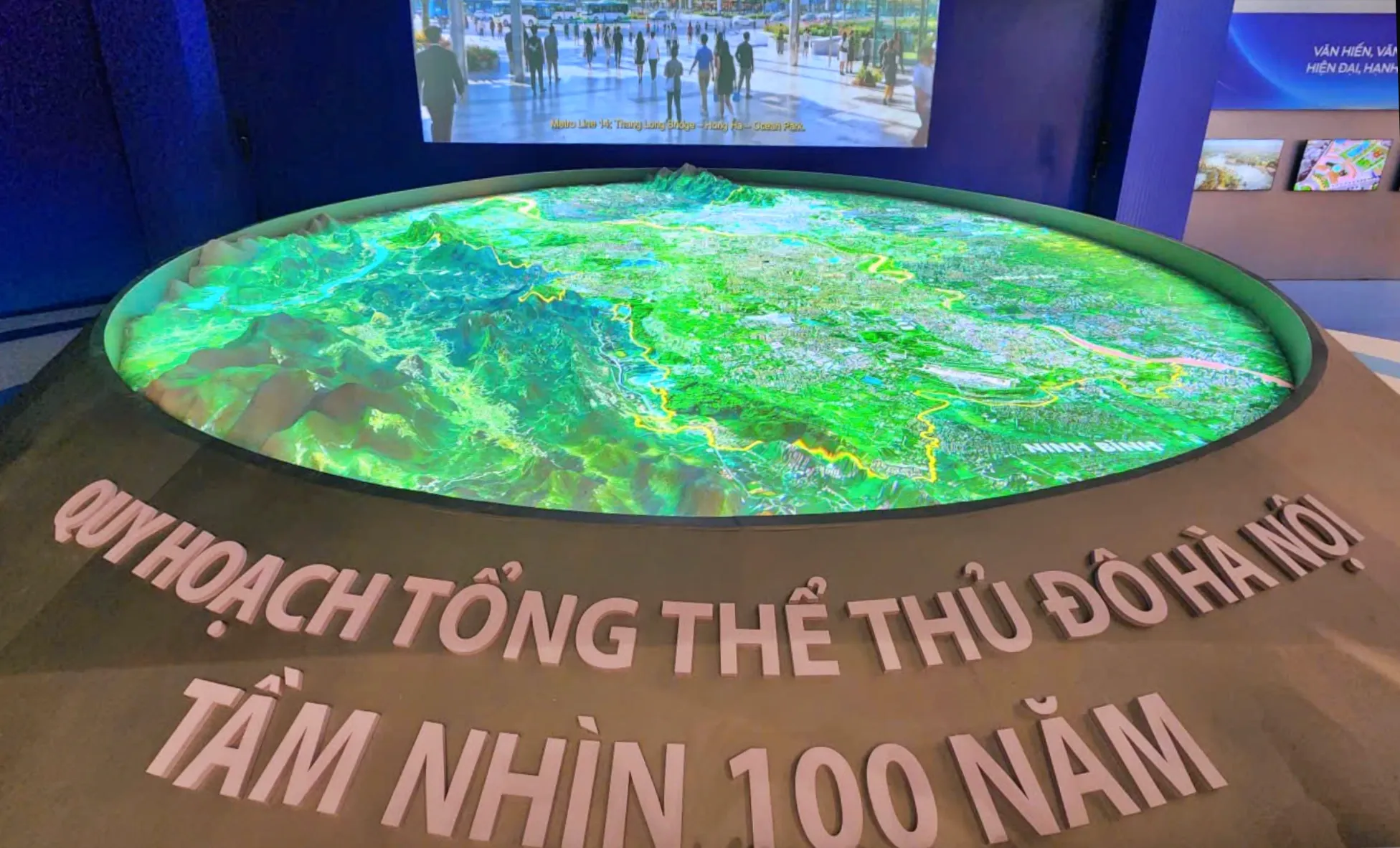
In the final days of June, at the Hanoi Museum, the scale model of the Capital’s Master Plan with a 100-year vision attracted broad public attention. More than a visual representation of Hanoi’s future urban structure, the model offered a new way of imagining the city in the century ahead: how Hanoi will grow, and how its rivers, landscape axes, urban centres, public spaces, cultural institutions and heritage areas will be organised within an unusually long-term vision.
Scale model of the Capital’s Master Plan with a 100-year vision. Source: Thanh Nien
Amid figures on land area, population, infrastructure, growth rates and new development poles, one question is of particular interest to the capital’s creative community: what room will this new spatial structure open up for Hanoi’s creative spaces?
This question is not only for architects, planners or urban managers. It is also a question for artists, designers, craftspeople, event organisers, heritage educators, independent spaces, studios, galleries, museums, craft villages, riverside communities and all those participating in the journey to build Hanoi as a Creative City.
The Capital Master Plan with a 100-year vision was approved under Decision No. 2512/QD-UBND dated 13 May 2026. It applies to the entire administrative boundary of the capital, covering approximately 3,359.84 square kilometres. This long-term plan is significant in shaping Hanoi’s development structure for a new stage, based on the integrated and synchronised orientation of spatial, economic, social, cultural, environmental and infrastructure development.
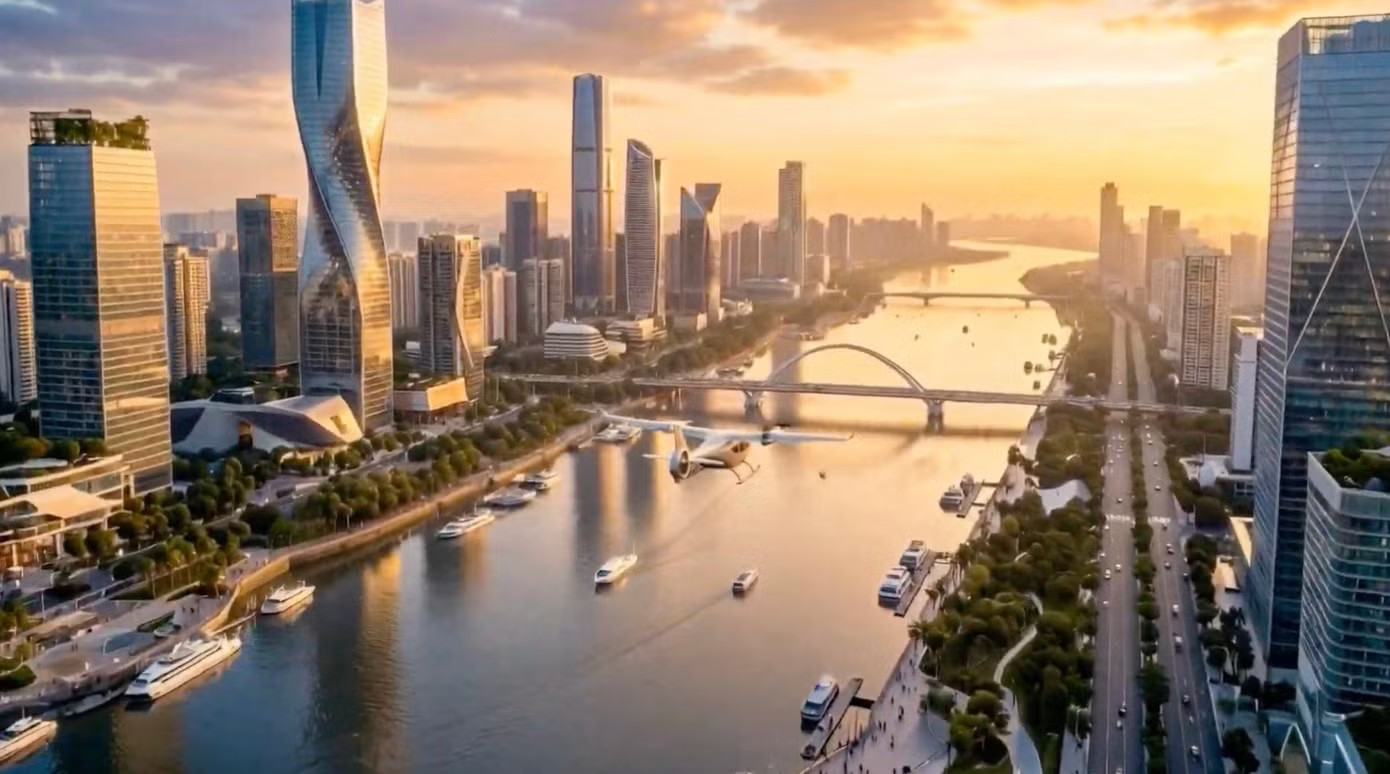
Hanoi’s Master Plan with a 100-year vision. Source: Hanoi People’s Committee
What is notable is that the plan does not place culture in a supporting role. In its development perspective, Hanoi identifies the goal of building a capital that is “Cultured – Civilised – Modern – Happy”, placing people at the centre, as both the subject, objective and driving force of development. This provides an important foundation for viewing the plan not merely as an infrastructure blueprint, but as a long-term framework for cultural and social development.
For the creative community, this is especially meaningful. A creative city cannot be made only by landmark buildings or major events. A creative city needs a spatial structure that allows people to meet, learn, experiment, produce, perform, exchange and co-create new values. By placing “culture and heritage” at the forefront, the plan also reminds us that Hanoi’s cultural identity must become a resource for development, not merely a memory to be preserved.
The master plan aims for a spatial model that is “multi-tiered, multi-layered, multi-polar and multi-centred”, with nine development poles, nine major centres and nine dynamic axes. In urban terms, this structure helps reduce pressure on the historic inner city, expands development space into new areas and creates additional functional centres with regional connectivity. In creative terms, it may offer Hanoi an opportunity not only to concentrate cultural and creative activities in the urban core, but also to gradually extend its creative network to suburban areas, craft villages, satellite towns, ecological corridors and heritage-rich zones.
At present, the Hanoi Network of Cultural and Creative Spaces has recorded 82 cultural and creative spaces across the city. These spaces are highly diverse: independent creative spaces, studios, galleries and art spaces; community and social organisation spaces; craft village and craft-based spaces; education and training spaces; as well as museums, heritage sites and cultural institutions. When this network is placed within the context of the Capital’s 100-year vision plan, the key question is no longer simply how many creative spaces Hanoi has, but how these spaces will be connected, protected, expanded and integrated into the city’s development structure.
One of the most important highlights of the plan is the Red River. According to the spatial development orientation presented by Hanoi People’s Committee leaders at a session of the People’s Council, the Red River landscape boulevard is identified as a central green spatial axis associated with creative culture along the Red River. At the same time, it is also positioned as an axis for socio-economic development, symbolising a Hanoi of “Heritage – Identity – Creativity”. This provides an important basis for viewing the Red River not only as a landscape, ecological or urban infrastructure corridor, but also as a cultural and creative corridor that can shape the capital’s new identity for decades to come.
Historically, the Red River has not only been a natural waterway, but also a cultural current that helped form Thang Long – Hanoi. Both banks of the river are associated with settlement, trade, craft villages, wharves, urban memory and many forms of community-based cultural practice. In recent years, riverside spaces have increasingly become venues for creative activities, from public art, photography, music, performances, workshops and creative markets to environmental education and community programmes.
If translated into appropriate zoning and detailed plans, the Red River axis could become a distinctive creative corridor for Hanoi. Along this corridor, green spaces, public spaces, cultural institutions, open-air museums, outdoor stages, walking routes, art stops, community practice spaces and riverside creative economy models could coexist. What matters is that development should not prioritise only urban, commercial or real estate functions, but should reserve a corresponding place for culture, creativity and community life.
From the perspective of Hanoi as a UNESCO Creative City in the field of Design, the 100-year vision plan opens up at least three layers of room for creative spaces.
The first is spatial room. As Hanoi develops under a multi-polar, multi-centred model, creative spaces have the opportunity to move beyond a few familiar areas in the inner city. Areas such as Son Tay, Hoa Lac, Dong Anh, Gia Lam, the Red River corridor, craft villages and new centres can become anchors for creative models linked to heritage, education, technology, ecology, craft and cultural tourism.
The second is functional room. Creative spaces should not be understood merely as places for exhibitions or events. They can also be places for content production, design experimentation, skills training, craft preservation, knowledge transfer, artistic performance, creative business incubation, cultural product development and community connection. If urban planning properly recognises this role, creative spaces can become part of the capital’s soft infrastructure for development.
The third is policy room. From the master plan to zoning plans, detailed plans and cultural industry development programmes, Hanoi has an opportunity to define more clearly the position of creative spaces within the city’s system of cultural institutions. This is a necessary step for creative spaces to move beyond isolated, short-term or spontaneous efforts, and to receive support through mechanisms related to land use, operation, resource connection, public-private partnership and participation in the city’s long-term development programmes.
However, a cautious view is still needed: the master plan remains at the level of strategic orientation. Values such as culture, creativity, ecology and happiness will only become reality if they are concretised in subsequent planning layers and specific projects. At this stage, it is important to continue monitoring the proportion, location and mechanisms reserved for cultural institutions, public spaces, creative spaces, design centres and creative destinations, as well as the participation of communities in the planning and implementation process.
This is also why the existing network of 82 cultural and creative spaces should be regarded as a valuable source of practical data. These spaces show where creativity is taking place in Hanoi, how it is happening, which communities are involved, what difficulties they face and what conditions they need for sustainable development. If the 100-year vision plan is the big map of the future, the existing network of creative spaces represents the living touchpoints of the present. Connecting these two layers will help Hanoi avoid a situation in which planning speaks about creativity at a conceptual level, but lacks mechanisms to protect and nurture concrete creative practices.
In the context of the Hanoi Creative Design Festival 2026, which is moving towards expanding community participation and promoting interdisciplinary cooperation in design, art, technology, architecture, craft, heritage, performance and data, the planning story becomes even more meaningful. The festival is not only a place to present ideas; it can also become a channel for dialogue between urban planning and the creative community. The selected initiatives, activated spaces and collaborative models tested through the festival can provide data, experience and proposals for the process of concretising the plan.
Conversely, the 100-year vision plan can also provide a foundation for the Hanoi Creative Design Festival and the Hanoi Network of Cultural and Creative Spaces to enter a new stage: from event to ecosystem, from temporary opening to long-term activation, from individual bright spots to a creative structure capable of connecting with urban development.
Thus, the question “What room does the Capital’s 100-year vision plan open up for Hanoi’s creative spaces?” can be answered on two levels.
At the level of orientation, the room is clear. The plan establishes culture as an important value axis, places people at the centre, considers the Red River a major ecological and cultural landscape axis, develops a multi-polar and multi-centred urban structure, and looks towards a Hanoi that is cultured, smart, creative and ecological.
At the level of implementation, however, this room still needs to be safeguarded through concrete decisions: which spaces are reserved for creativity, which institutions are prioritised, which communities are invited to participate, which models are supported, and which mechanisms will enable creative spaces to survive over the long term under the pressure of urbanisation.
A 100-year plan does not only answer questions about how tall, how wide or how connected a city will be. For Hanoi, such a plan must also answer how the city will preserve memory, nurture creativity, open space for communities and turn culture into a resource for development.
From the scale model at the Hanoi Museum to the network of 82 cultural and creative spaces, from the Red River axis to craft villages, from the Hanoi Creative Design Festival 2026 to everyday creative practices, it is clear that the future of the Creative City does not stand outside planning. On the contrary, planning itself will be one of the decisive conditions for Hanoi to turn its Creative City title into a truly creative life — sustainable, open and belonging to the community.