
Dong Xuan–Bac Qua: From Heritage Space to New Creative Infrastructure for Hanoi
In the heart of Hanoi’s Old Quarter, where layers of history, commerce and community life have shaped the urban landscape, a new institution is taking shape: the Dong Xuan–Bac Qua Cultural Industries Centre. The official groundbreaking ceremony on October 8 marked more than the addition of another cultural venue to the Hoan Kiem area. More significantly, it signalled a shift from time-limited creative events towards the development of lasting infrastructure for a Creative City.
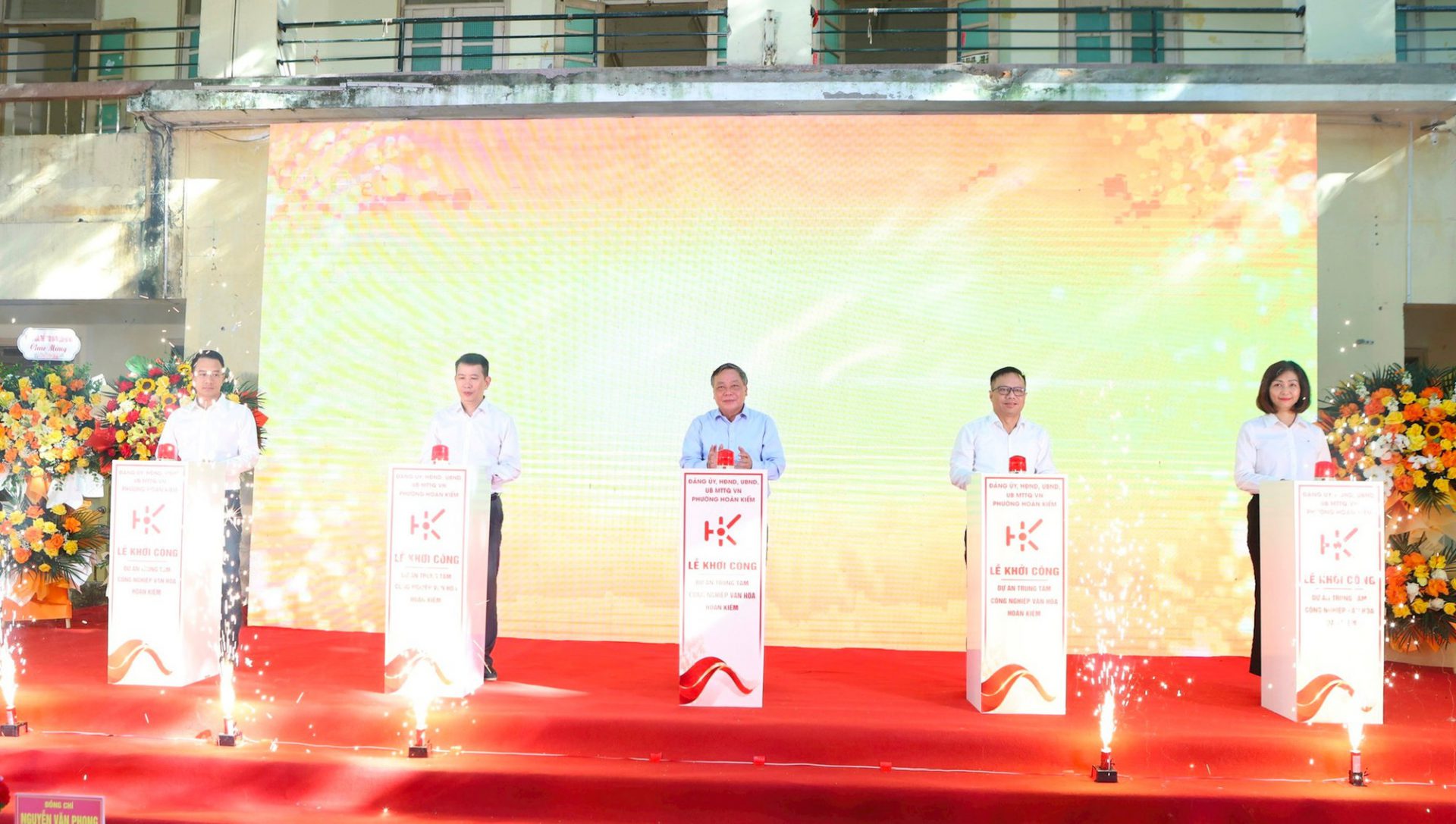
Hanoi Party Committee Deputy Secretary Nguyen Van Phong and delegates press the button to officially launch construction of the Dong Xuan–Bac Qua Cultural Industries Center project
On the morning of October 8, the Hoan Kiem Ward People’s Committee held a groundbreaking ceremony for the renovation and refurbishment of two sites at 17 Nguyen Thien Thuat Street and 40 Thanh Ha Street, while also announcing the decision to establish the Dong Xuan–Bac Qua Cultural Industries Centre.
The centre will occupy a site covering approximately 3,862 square metres, with a building footprint of around 2,317 square metres and a site coverage ratio of approximately 60 per cent. Construction is expected to be completed around the April 30–May 1 holiday period in 2027.
Under the announced development plan, the centre is not intended to function as a conventional cultural centre or exhibition venue. Instead, it is conceived as a multifunctional cultural industries complex, bringing together creative spaces, displays and exhibitions, art galleries, studios, arts and crafts, performances, education, experiential activities, cultural product showcases, gastronomy, cultural commerce and support for creative start-ups.
In other words, the ambition extends beyond creating another venue for events. It is to establish an environment where artists, artisans, designers, businesses and communities can meet, develop products together and generate new economic value from culture.
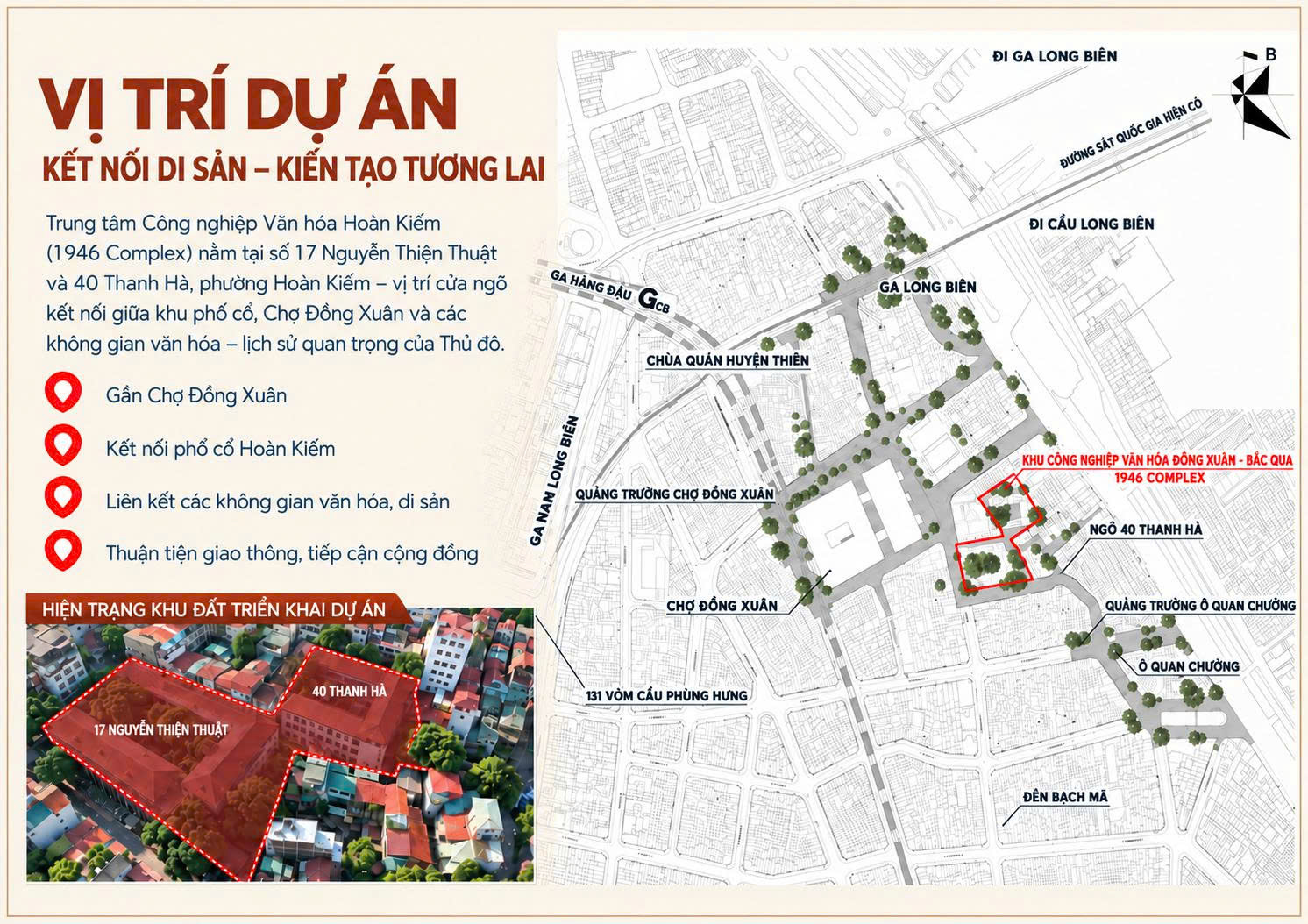
Project Layout Diagram
A Location Chosen for a Reason
Dong Xuan–Bac Qua occupies a distinctive position within Hanoi’s Old Quarter.
The area has long been a centre of trade, while also being closely connected to a network of traditional craft streets, markets, architecture, culinary traditions and forms of urban life accumulated over generations. Dong Xuan Market has historically served not only as a major commercial hub but also as an integral part of Hanoi’s Ke Cho trading-town structure.
Establishing a cultural industries centre here therefore carries a different significance from constructing a cultural facility on a newly developed site.
The challenge is to ensure that a new creative institution becomes part of the Old Quarter’s existing urban life rather than operating as an isolated enclave.
Speaking at the groundbreaking ceremony, Trinh Hoang Tung, Chairman of the Hoan Kiem Ward People’s Committee, emphasised that preserving a city with a rich historical legacy does not mean keeping everything unchanged. What matters is creating the conditions for heritage values to continue evolving, inspiring creativity and being passed on to future generations.
This is also one of the central challenges facing Hanoi as a UNESCO Creative City: conservation does not mean freezing a place in time, just as creativity does not necessarily require demolishing the old to make way for something entirely new.
Between these two extremes lies another path: using design, art, technology and new business models to enable heritage to remain an active part of contemporary life.
From the Creative Design Festival to Creative Infrastructure
The significance of the Dong Xuan–Bac Qua Centre becomes even clearer when viewed in the context of the Hanoi Creative Design Festival 2026.
Under the programme framework announced by the city, the Dong Xuan–Bac Qua Market area and the Dong Xuan Cultural Industries Centre have been designated as the Heritage Space, one of the festival’s principal venues.
The vision for this area is to connect heritage with creativity, pilot new models of cultural and commercial development, and encourage interaction between artisans, designers and market traders. Through these activities, the city aims to gradually establish a route combining heritage, creative experiences and commerce.
What is particularly noteworthy is the shift in the approach to organising creative activities.
In the past, a creative festival was often understood primarily as a series of exhibitions, performances or public activities taking place over a defined period. Hanoi, however, has placed the 2026 Creative Design Festival within a broader objective: building an urban creative ecosystem.
The Dong Xuan–Bac Qua Centre can be seen as a tangible expression of this transition.
An event may end after a few days or weeks. A creative institution, if it operates effectively, can sustain relationships among artists, businesses, designers, artisans and communities for years.
This marks a transition from “organising creative activities” to “creating the conditions for creative activities to have a lasting home”.
It is important, however, to distinguish between the festival programme and the centre’s construction schedule. The project has only recently entered the construction phase and is expected to be completed in 2027. Therefore, although the Dong Xuan–Bac Qua area forms part of the Heritage Space at the Hanoi Creative Design Festival 2026, this should not be taken to mean that the entire new centre will be completed and operational during this year’s festival.
Indeed, this transitional period suggests that the 2026 festival could serve as a testing ground for models that will continue to operate long after the event itself has ended.
What Should a Cultural Industries Centre Deliver?
A renovated building can become an attractive space. But to function as a cultural industries centre in the fullest sense, its value must ultimately be measured by what happens within its walls and the connections it creates beyond them.
An artisan might meet a designer and collaborate on developing a new product.
A studio might produce content inspired by the heritage of the Old Quarter.
A gallery might bring artists’ works to wider audiences and markets.
An educational programme might help students explore the history of the neighbourhood through new interactive approaches.
A creative enterprise might test a new product, while a start-up team could find both a community and a market. Meanwhile, visitors could discover Hanoi not simply by sightseeing at historic monuments, but through experiences involving design, craftsmanship, art and contemporary urban life.
When these activities connect with Dong Xuan Market, the Old Quarter, networks of traditional craft streets and villages, and other cultural spaces, a centre occupying less than 4,000 square metres could generate an impact extending far beyond its physical boundaries.
This is also the underlying logic of the cultural industries: value lies not only in a building itself, but in the networks of cultural production, creation, distribution and consumption that it can help activate.
A Test for Hanoi as a Creative City
Hanoi joined the UNESCO Creative Cities Network in 2019 as a Creative City of Design. After years of organising festivals, expanding its network of creative spaces and developing new policy mechanisms, the increasingly important question is no longer how many creative events the city can organise.
The question is what lasting value those activities leave behind.
The Dong Xuan–Bac Qua Cultural Industries Centre is therefore significant not merely because of its groundbreaking ceremony or the scale of investment. Its greater importance lies in the fact that Hanoi is beginning to translate part of its Creative City vision into tangible infrastructure, with a specific location, physical facilities and a proposed operating model.
The real test will come after construction is completed.
A cultural industries centre can only thrive when artists want to work there, businesses recognise opportunities, artisans find partners, young people want to return, local residents feel that they belong, and visitors have reasons to experience the place more than once.
If these conditions are achieved, Dong Xuan–Bac Qua could become a compelling example of how a historic city can do more than preserve its past. It can draw upon that very past as a resource for shaping its future.
And this may become one of the most tangible expressions of Hanoi as a Creative City: a transition from festivals to lasting institutions, from ideas to infrastructure, and from preserved heritage to heritage that continues to generate new value.
Sources
- Vietnam News Agency – News and Ethnic Affairs Newspaper, “Hanoi: Groundbreaking Ceremony for Dong Xuan–Bac Qua Cultural Industries Centre”, October 8, 2026.
- Government Electronic Information Portal, “Hanoi Creates a New Cultural and Creative Destination in the Dong Xuan–Bac Qua Area”, October 8, 2026.
- Hanoi City Electronic Information Portal, Programme Framework for the Hanoi Creative Design Festival 2026 and the Development Vision for the Dong Xuan–Bac Qua Heritage Space.